Contend Earnestly

Thursday, November 13, 2008

Desire of God: James White and Phil Johnson

So, Turretinfan decided to put this up as an answer to what does it mean that God desires the salvation for the reprobate. He quotes Phil Johnson on this:

"The word desires is problematic, however, because it implies an unfulfilled longing in the Almighty, and that is inconsistent with biblical affirmations of divine sovereignty such as Psalm 115:3 ("Our God is in the heavens: he hath done whatsoever he hath pleased"). God doesn't have unfulfilled longings, frustrated wishes, or unsatisfied appetites. He doesn't "desire" anything in the sense we normally employ the term. Yet it is extremely difficult if not impossible to deal faithfully with the biblical passages describing God's demeanor toward the wicked who perish without employing the language of desire. Scripture itself freely uses such expressions (Ezek. 18:23, 32; 33:11; Lam. 3:33)."

I will say that I found out where this quote came from and this quote comes in the notes of something that R.L. Dabney wrote. In this part Dabney gives an example of how he sees God's desire for the reprobate. He states (the whole article can be found here) :

A certain Major André had jeopardized the safety of the young nation through "rash and unfortunate" treasonous acts. Marshall says of the death warrant, signed by Washington, "Perhaps on no occasion of his life did the commander-in-chief obey with more reluctance the stern mandates of duty and of policy." Dabney observes that Washington's compassion for André was "real and profound". He also had "plenary power to kill or to save alive." Why then did he sign the death warrant? Dabney explains, "Washington's volition to sign the death-warrant of André did not arise from the fact that his compassion was slight or feigned, but from the fact that it was rationally counterpoised by a complex of superior judgments . . . of wisdom, duty, patriotism, and moral indignation.

Further, we find Phil Johnson elsewhere showing what he means by desire on his blog Pyromaniacs. He states in this post (in the comments section):

Anyone who knows me knows that I'm strongly committed to the idea that God in some meaningful sense seeks and "desires" the repentance of every sinner. (Note: I use the d-word advisedly, acknowledging that optative expressions when used of God are always problematic and never quite accurate. But I don't know a better way to say it; and denying it outright would seem to suggest that God's commands and beseechings are not well meant.) Anyway, I believe God expresses a bona fide preference and sincere plea for the salvation of sinners rather than their damnation, and that it's perfectly appropriate to tell any sinner that God loves him or her.
Phil Johnson

Now this is how Phil Johnson clears up his thoughts on God's desire. It seems as though Phil would agree that although this desire is a mystery, as John Murray has said, it is still present and bona fide.

Here is where all this started. I compare the above with what James White said on his radio show The Diving Line and found something that denies God's desire for the reprobate. Here is that quote (full discussion and audio can be found here) :

"Yeah, and that's one of the problems I have with Ezekiel 18 or 33 being read into this particular issue, because I feel like we're being forced to somehow attribute to God some kind (for some reason)...some kind of an attitude or desire that I just never see, not only do I never see expressed, but it would likewise force us to say that God has an unfulfilled desire, but it's not really the same desire as he chooses to fulfill with other people. And we're left not only--you're not only left with the two-wills conundrum, now you've got multiple desires conundrums, which I don't, I just don't see a reason for it. The Ezekiel texts are talking to people who were saying that there was no reason for them to repent because they're already doomed because of the sins of their forefathers. That's why they repeated the parable of their teeth being set on edge because of the sour grapes that their fathers had eaten, and so on and so forth. And so what I hear Ezekiel as saying is an apologetic response to people who were saying there's no reason to preach to those people, there's no reason for us to even listen to the message of the prophets, because our repentance would never be accepted. Now that's different than Isaiah's commissioning where God specifically commissions him to proclaim a message of judgment, and says he's going to harden the hearts of the individuals who hear it. That's a completely different context. But, I just don't, if someone can explain to me where the idea comes from that we have to attribute to God a desire that he then does not fulfill.
James White

This is the conundrum. From my comparison of James White with Phil Johnson and John Murray, and others, James White errs in this thought.

The reason that I labeled this understanding as a hyper Calvinist thought is found when Ian Murray quotes Spurgeon at length of what constitutes a hyper Calvinist. You can find that here.

I still see a difference in James White and Turretinfan vs Phil Johnson, John Murray, R.L. Dabney and Charles Spurgeon.


Read More......

Wednesday, November 12, 2008

God's Desire of Salvation for All

We have been going back and forth here a little bit on what it means that God desires for all men to be saved. From what I have discerned from James White's response here, is that he is a little to soft in his assertion of God's will or desire. It seems as though that White would only agree to the fact that by the proclamation of the gospel to all, by men, would show his desire for all to be saved. What it seems White draws the line at is God's personal desire for all men to be saved. Although I believe that the way God displays his desire is found in the proclamation of the gospel, it doesn't merely stop there. I find that God truly desires or wishes in his person that all men be saved. To understand this more fully, one has to ascribe to the "two-wills" theory of God to be able to say that God desires fully for someone to be saved, yet also leaves them as the reprobate. Murray calls this a mystery as he states these two summations here:

II Peter 3:9. In view of what we have found already there is no reason in the analogy of Scripture why we should not regard this passage as teaching that God in the exercise of his benevolent longsuffering and lovingkindness wills that none should perish but that all should come to repentance. An a priori assumption that this text cannot teach that God wills the repentance and salvation of all is a gravely unsound assumption, for it is not an assumption derived from the analogy of Scripture. In approaching this text there should be no such prejudice. What this text does actually teach will have to be determined, however, by grammatico-historical exegesis of the text and context.

(2) We have found that God himself expresses an ardent desire for the fulfilment of certain things which he has not decreed in his inscrutable counsel to come to pass. This means that there is a will to the realization of what he has not decretively willed, a pleasure towards that which he has not been pleased to decree. This is indeed mysterious, and why he has not brought to pass, in the exercise of his omnipotent power and grace, what is his ardent pleasure lies hid in the sovereign counsel of his will. We should not entertain, however, any prejudice against the notion that God desires or has pleasure in the accomplishment of what he does not decretively will.

We can also see that John Piper would say the exact same thing in his short treatise on this subject:

To avoid all misconceptions it should be made clear at the outset that the fact that God wishes or wills that all people should be saved does not necessarily imply that all will respond to the gospel and be saved. We must certainly distinguish between what God would like to see happen and what he actually does will to happen, and both of these things can be spoken of as God's will.

Piper then tells a story given by Dabney about George Washington. The following is told:

Dabney uses an analogy from the life of George Washington taken from Chief-Justice Marshall's Life of Washington. A certain Major André had jeopardized the safety of the young nation through "rash and unfortunate" treasonous acts. Marshall says of the death warrant, signed by Washington, "Perhaps on no occasion of his life did the commander-in-chief obey with more reluctance the stern mandates of duty and of policy." Dabney observes that Washington's compassion for André was "real and profound". He also had "plenary power to kill or to save alive." Why then did he sign the death warrant? Dabney explains, "Washington's volition to sign the death-warrant of André did not arise from the fact that his compassion was slight or feigned, but from the fact that it was rationally counterpoised by a complex of superior judgments . . . of wisdom, duty, patriotism, and moral indignation [the wide-angle lens]."

Dabney imagines a defender of André, hearing Washington say, "I do this with the deepest reluctance and pity." Then the defender says, "Since you are supreme in this matter, and have full bodily ability to throw down that pen, we shall know by your signing this warrant that your pity is hypocritical." Dabney responds to this by saying, "The petulance of this charge would have been equal to its folly. The pity was real, but was restrained by superior elements of motive. Washington had official and bodily power to discharge the criminal, but he had not the sanctions of his own wisdom and justice." The corresponding point in the case of divine election is that "the absence of volition in God to save does not necessarily imply the absence of compassion." God has "a true compassion, which is yet restrained, in the case of the . . . non-elect, by consistent and holy reasons, from taking the form of a volition to regenerate." God's infinite wisdom regulates his whole will and guides and harmonizes (not suppresses) all its active principles."

In other words, God has a real and deep compassion for perishing sinners. Jeremiah points to this reality in God's heart. In Lamentations 3:32-33 he speaks of the judgment that God has brought upon Jerusalem: "Though he causes grief, he will have compassion according to the abundance of his steadfast love; for he does not willingly afflict or grieve the sons of men." The word "willingly" translates a composite Hebrew word (milibo) which means literally "from his heart" (cf. 1 Kings 12:33). It appears that this is Jeremiah's way of saying that God does will the affliction that he caused, but he does not will it in the same way he wills compassion. The affliction did not come "from his heart." Jeremiah was trying, as we are, to come to terms with the way a sovereign God wills two different things, affliction and compassion.

This is all trying to answer the question of Turretinfan on what I mean when I say, "desire/wish." Turretinfan and James White both try and undercut this by answering a question with a question. They both ask, (my loose quotation) "Are you stating that God is somehow disappointed or frustrated with the fact that something he desired did not come to pass?"

To be honest, I will stick with Murray on this and say that it is a mystery how this comes to pass.

The way that Piper explains this mystery is as such:

Putting it in my own words, Edwards said that the infinite complexity of the divine mind is such that God has the capacity to look at the world through two lenses. He can look through a narrow lens or through a wide-angle lens. When God looks at a painful or wicked event through his narrow lens, he sees the tragedy or the sin for what it is in itself and he is angered and grieved. "I do not delight in the death of anyone, says the Lord God" (Ezekiel 18:32). But when God looks at a painful or wicked event through his wide-angle lens, he sees the tragedy or the sin in relation to everything leading up to it and everything flowing out from it. He sees it in all the connections and effects that form a pattern or mosaic stretching into eternity. This mosaic, with all its (good and evil) parts he does delight in (Psalm 115:3).
John Piper

So, to end this questioning, I believe and have found the Reformers to believe the same. Namely, that God's emotions are complex and we cannot understand them fully, but I do adhere to the fact that God does indeed desire/wish with deep compassion that all men be saved, but in his eternal secretive decree has chosen some and passed over others for his glory. To get a quick understanding of the two wills theory, please read Piper in its entirety here.

If James White or Turretinfan believe in these facts of God's actual desire/wish for all men to be saved (Ezekiel 18; Ezekiel 33; 1 Timothy 2:4; 2 Peter 3:9 and John 3:16) then I will retract what I have stated.


Read More......

Tuesday, November 11, 2008

Question for James White on God's Desire

It looks like yesterday's post created quite a stir with James White and Turretinfan. James White decided to bring up the post and talk on it for about 10 minutes yesterday on his radio program called The Dividing Line. James White wasn't happy so he attacked some, which I would have done as well, so I don't hold that against him in any way. It is cool, part of the process since we don't know each other at all. It must also be very difficult for him being in the public eye and getting complaints from all sorts of whack jobs and weirdos. Although Dr. White doesn't know this, I have read many of this books and have listened to many of his debates. Again, I greatly appreciate much of what White does on the "front lines" of evangelism and I went to his Shabir Ally debate here in Seattle and wrote a review of it here. I want to also express that I need to be more specific. On the desire or wish of God for all to be saved, if one denies this, it has historically been a tenant of hyperism. So, although James White might not be a hyper Calvinist as a whole, on this doctrine, based on this exchange, it would seem that in this specific area of his theology, he would be affirming a hyper Calvinist conviction. But, I feel as though I need to "make sure" of this so that is the reason of this post.

So, the one thing that has had me concerned with White is his thoughts on God's desire or wish for all men to be saved, which would then flow out of this the "well meant offer" of the Gospel to all men. One of the challenges that White posed to me was simply, "show me where I differ in regards to the 1689 Baptist Confession." (loose quotation). Now, lets be honest. White can run circles around me theologically. I am no fool to think otherwise, but I bet I could beat him in an arm wrestling contest :). What I am going to do is simply ask him if he agrees with the following statements and men, and if he doesn't I simply ask if he can define what he believes as far as God's desire or non-desire for all men to be saved and show historically any men that would agree with his definition. I will first quote Dr. Samuel Waldron from A Modern Exposition of the 1689 Baptist Confession of Faith.


"The doctrine of this text that God earnestly desires the salvation of every man who hears the gospel and thus freely offers Christ to them is confirmed throughout the rest of Scripture. The Bible teaches that the good gifts which God bestows upon men in general, including the non-elect, are manifestations of God's general love and common grace towards them (Matt. 5:43-48; Luke 6:35; Acts 14:17). While they do serve to increase the guilt of those who misuse them, this is not the sole intention of God towards the non-elect in giving them. The Scriptures teach that God desires the good even of those who never come to experience the good wished for them by God (Deut. 5:29; 32:29; Ps. 81:13-16; Isa. 48:18). The Scriptures also teach that God so loved sinners that in the person of his Son he weeps because of the destruction they bring upon themselves (Matt. 23:37; Luke 13:34; 19:41-44). God emphatically expressses his desire that some should repent who do not repent (Ezek. 18:23, 32; 33:11; Rom. 10:11). The Scriptures teach a general gospel call which comes to the hearers of the gospel indiscriminately and which may be, and often is resisted (Prov. 1:24; 8:4; Isa. 50:2; 65:12; 66:4; Jer. 7:13-14; 35:17; Matt. 22:14).

This biblical witness does not overthrow the scriptural teaching of an unconditional election and an irresistable grace. When our finite minds contemplate the glory of the incomprehensible God revealed in the Scriptures we often will be unable to penetrate completely how two seemingly contradictory truths may be reconciled. It ought, however, to rid us of every hesitation in calling men indiscriminately, passionately, freely and authoritatively to embrace Jesus Christ as he is freely offered in the gospel."
Samuel E. Waldron, Modern Exposition of the 1689 Baptist Confession of Faith (Evangelical Press, 1989), p.122

I would also ask if James White would agree with John Piper and John Murray on this topic as well.

Also, if not, which historic men of the Christian faith would agree with his conclusions on God's desire and/or wish of the unregenerate?

That is all for now. These are mere questions and I hope to get a clear understanding of what James White believes on this desire. And next time he is in Seattle I will buy him lunch and let him tear me apart theologically.

Read More......

Monday, November 10, 2008

When Friends Err: Part I

This is a very hard subject. What do we do when our friends in ministry are in error on theological subjects and others point it out? Because I am not in the spotlight like some, although I have dealt with this subject, I haven't dealt with the subject in the public eye. I have had to correct friends of mine who have taught error and had to correct them in front of groups because of questions being posed to me because of the teaching of this individual. It wasn't easy, but it was necessary. Did this person hold it against me? Actually no. I went to him beforehand to let him know and then proceeded to do in a way that hopefully was very God honoring.

The issue I have is the fact that we have those in the public eye, who come up with formulas of labeling others, but when faced with one of their friends in this area they start to back peddle. It is really some sort of friendship bias because they "know" the person. To me, this doesn't make sense. What good is it to have clearly defined labels if they aren't followed through with? What good is it to clearly define some dangers in the modern evangelical circles if when these definitions are then put to friends that those who pose these definitions back off? This is clearly dangerous to do, and very confusing.

I know you are crying for examples so let me give you some. One is general and then the others will be specific. The most general one that I find are with those religions that we deem as against Protestant Christianity. We preach and defend against these, whether it is Roman Catholicism, Buddhism, Mormonism or Islam. What I find interesting is that preachers around the nation don't have the balls to follow through with their exclusive claims of the cross. If we believe that only those who believe in Jesus Christ are saved, then if someone doesn't not believe in the efficacy of the Christ and His atonement, then they are outside of the faith. What is found though, is that when some are pressured, they will throw up their hands and say, "I leave that to God." While I understand this to an extent, and the statement is ultimately true, we should have the guts to at least state, "If they do not believe in the Christ alone, and his efficacy, then they are outside of the faith and will go to hell." This is a far better response than what we have found with some within contemporary circles (here and here). Take a stand. Say something to defend Jesus, not your friend.

Specifically now.

Last year I visited the Resurgence Conference 2007 with Bruce Ware. I really like Bruce Ware and believe his thoughts on the atonement and his convictions in general are much like my own. Dr. Ware's most widely heard ministry is against Open Theism. The conference that I attended was called, "Where the Hands of God and Hands of Man Meet." It was about Calvinism (Reformed), Arminianism and Open Theism. Bruce Ware went through a complete weekend of just hammering Open Theist positions and called out their error quickly and succinctly. He even brought up a great passage when speaking to the Open Theist in Isaiah 41:21-24

“Present your case,” the Lord says.
“Bring forward your strong arguments,”
The King of Jacob says.
Let them bring forth and declare to us what is going to take place;
As for the former events, declare what they were,
That we may consider them and know their outcome.
Or announce to us what is coming;
Declare the things that are going to come afterward,
That we may know that you are gods;
Indeed, do good or evil, that we may anxiously look about us and fear together.
Behold, you are of no account,
And your work amounts to nothing;
He who chooses you is an abomination.
Isaiah 41:21-24

This put me over the edge of thinking that Open Theism is outright heresy. We then found out that Bruce Ware, under his own admission, was close friends with some of the major proponents to this thought. Bruce broke this passage down to show that the Open Theist is worshiping another god and not the God of the Bible. So, during the Q&A someone asked, "Would you then consider Open Theism as heresy?" Bruce Ware responded by saying, "no, I would not. I have close friends who are open theists and find them to love Jesus very much." I had issues with this, so I stood up and had to question this. I put forth the logic to Dr. Ware that if we can't say that my mormon friend loves Jesus, therefore he is "in" then how is this different than his Open Theist friends? He responded that it was different. I then asked, "How is this different? You taught that they worship another god and that those who choose this god is an abomination. Do you know of anywhere in the Scriptures where a regenerated elect person of God is ever called an abomination?" He quickly moved on and didn't really respond to my questioning. He, by this Q&A just tore down his entire argument for the past couple of days. I was thinking, "Why is this such a big deal if they are one of the elect and saved?" It seemed like double talk. I greatly respect Dr. Ware, but this made little sense to me. I felt like he was giving a "pass" because his friends were involved in this area of theology.

Another example is more recent. This one involves James White and Phil Johnson. I respect Phil a lot yet find him sometimes irritating, probably because in our demeanor we are a lot a like. Phil and others historically have given definitions of what is deemed as hyper-Calvinism. If you want to see a great break down of the different levels of moderate, high and hyper Calvinism, check out Tony's chart here.

One of the defining points of hyperism is the thought that God has no desire to save the reprobate. Historically, Calvinism has thrown this idea back and forth, but landed with the fact of the two wills theory that was a proponent of Calvin himself. Meaning, that God has a revealed will and a secretive will. Meaning that although God desires all people to be saved, in his secretive will, not all can be saved. He chose some, and past over others for his own glory by the consulting of his own will alone. This would fall in line with the following:

“Do I have any pleasure in the death of the wicked,” declares the Lord God, “rather than that he should turn from his ways and live?
Ezekiel 18:23

“Say to them, ‘As I live!’ declares the Lord God, ‘I take no pleasure in the death of the wicked, but rather that the wicked turn from his way and live. Turn back, turn back from your evil ways! Why then will you die, O house of Israel?’
Ezekiel 33:11

There is much more to this argument and very easy to show that God does indeed desire for all men to be saved. Classic Calvinism would definitely agree with this as well. The problem here is that Phil Johnson has clearly laid out this definition of hyper Calvinism here and James White clearly denies the free offer and God's desire here. After reading the two, it is clear that James White falls into the historic definition (notice I said definition of, not labeling him as one outright) of a hyper Calvinist. But, we find Phil Johnson defending his friend here. I understand wanting to defend a friend, but this really is out of bounds to leave all definitions of what it means to be a hyper Calvinist and defend someone because you like them and have seen them in action. I don't think any of us are saying that James White doesn't go out and evangelize or defend the faith. That isn't what the question is here. The question and definitions are solely from a theological understanding on the free offer and desire of God. On this, James White is sorely in error, yet Phil Johnson seems to defend this error for only the reason of a friend being caught up in it. Just my perception.

This is disheartening for sure. What I hope happens behind closed doors is for Phil and James White to have some good discussions on the free offer and desire of God and for James White to be corrected in his error. But, I will tell you that James White's response to this allegation is immature and laughable. Instead of arguing from Scripture, like he tells all of his opponents to do, he merely tries to draw up straw men and argue from practice by belittling his opponents. Dr. White, just because you happen to be defending the faith on the weekend that this conference was going on, doesn't mean that this clears your name as a proponent of the historical claims of the gospel. At least be honest and respond in the ways that you desire your opponents to respond. Because if they would have made the same claims that you did in your response, you would have laughed at them and undercut them the first chance you got.

:::UPDATE:::

Let me say this. I would argue that because of White's definition and understanding of God's desire (found here) that this would at least be deemed as having hyper tendencies. He might not be a hyper Calvinist outright, but it would seem as though some of his thoughts on the desire and free offer would lean the way of the hyper Calvinist.

Tomorrow we will look at what we should do when a friend is found to be in error theologically and others notice this error and ask us about it.

Read More......

Saturday, November 08, 2008

L'Abri and Schaeffer's Legacy

I found a very well done article at Christianty Today on the current state of Schaeffer's L'Abri in Switzerland. It is sad where it has gone and what is also interesting is that those that are at L'Abri are out of touch with their own postmodernism. They make some very incoherant statements about postmodernism and Schaeffer himself and I find it very irritating. One statement is that Schaeffer's work is outdated because he was working against modernism, which questioned basic truths, but now we work with postmodernism that asks, "Is there anything that is absolute truth?" The problem with their conclusion at L'Abri is that they figure that people today don't want to know truth, which they do and are searching for. Schaeffer's work still stands because it will take the postmodern to the fact that there not only is truth, but Christianity is that truth they are seeking for.

I am saddened to read how far L'Abri has deserted Schaeffer's desire, but I guess it shouldn't with the state of our crappy, who cares attitude with standing for the faith in the United States. Take a look at this article, as it actually gives a glimpse into what is going on with those young people who are questioning truth altogether.

Not Your Father's L'Abri

Read More......

Friday, November 07, 2008

Our Unique Opportunity: Francis Schaeffer


I am currently reading "The God Who is There" by Francis Schaeffer and am really enjoying it. I am very angry at myself for not reading him earlier in life. He is truly amazing in thought and practice. I came to this thought from him and thought I would share it. Enjoy, and have a great weekend:

But we cannot take advantage of our opportunity, if we let go in either thought or practice that methodology of antithesis (that is, that A is A and A is not non-A). If a thing is true, the opposite is not true; if a thing is right, the opposite is wrong.

If our own young people within the churches and those of the world outside see us playing with the methodology of synthesis, in our teaching and evangelism, in our policies and institutions, we can never expect to take advantage of this unique moment of opportunity presented by the death of romanticism. If we let go of our sense of antithesis, we will have nothing left to say.


Moreover, not only will we have nothing to say, we become nothing. Christianity ceases to exist, though it may still keep its outward institutional form. Christianity demands antithesis, not as some abstract concept of truth, but in the fact that God exists, and in personal justification. the biblical concept of justification is a total, personal antithesis. Before justification, we were dead in the kingdom of darkness. The Bible says that in the moment that we accept Christ we pass from death to life. This is total antithesis at the level of the individual man. Once we begin to slip over into the other methodology- a failure to hold on to an absolute which can be known by the whole man, including what is logical and rational in him- historic Christianity is destroyed, even if it seems to keep going for a time. We may not know it, but when this occurs, the marks of death are upon it, and it will soon be one more museum piece.


To the extent that anyone gives up the mentality of antithesis, he has moved over to the other side, even if he still tries to defend orthodoxy or evangelicalism. If Christians are to take advantage of the death of romanticism, we must consciously build back the mentality and practice of antithesis among Christians in doctrine and life. We must do it by our teaching and by example in our attitude toward compromise, both ecclesiastically and in evangelism. To fail to exhibit that we take truth seriously at those points where there is cost in our doing so, is to push the next generation int the relative, dialectical millstreams that surrounds us.


Finally, and with due reverence, may I emphasize that not only should we have genuine compassion for the lost among whom we live, but also concern for our God. We are His people, and if we get caught up in the other methodology, we have really blasphemed, discredited, and dishonored Him - for the greatest antithesis of all is that God exists as opposed to His not existing; He is the God who is there.

Read More......

Thursday, November 06, 2008

The Symbolism of the Cross


I had written a post about a former student of mine doing a speech in her English class, in a public school, on the cross. I thought I would go ahead and post her speech here so all could read. It is very interesting to see how a 16 year old stands for the understanding of the cross. It is nice to see that my teaching has impacted someone so greatly that they still write and keep me informed of what is going on with their witness. It is truly good to see God's grace work in her life. I have given her some ideas as well for further speeches and also challenged her to open up lines of communication with those in her class to seek further conversation on the cross.

Cross Symbolism

For many people, when they see just another religious symbol, they could care less what it means or symbolizes. Especially if it is of another religion other than their own, or if they don’t even put themselves in a “religious category.” I want you in this moment to clear your mind of all previous knowledge and just listen to what the Christian cross means.

Jesus was born to a young peasant woman in the area we know as present day Israel 2000 years ago. We, as a civilization, revolve our history using time that was divided by his birth. Do B.C. and A.D. sound familiar? They stand for “before Christ” and “Anno Domini,” meaning the year of our Lord.

Until he was thirty, Jesus lived a traditional Jewish life, working as a carpenter. During this time, the whole area was under Roman dictatorship ruled by Caesar, including Bethlehem, where Jesus was born, and Nazareth, where he was raised.

In his thirties, Jesus began his public teaching and display of recorded miracles, but always stayed fairly close to home. Over a three-year period, despite trying to keep a low profile, Jesus' acts and teachings spread nation wide. The Roman government took notice to this person who spoke such nonsense. God offers love and forgiveness? That you are actually worth something and can have hope? What was this nonsense? They took him in and sentenced him to death. He was beaten, whipped and mocked, then forced to carry his own wooden cross to a hill outside of the city walls. They hammered nails through his wrists and feet. Scholars say he slowly suffocated to death. Do you hate the feeling you get when you can’t hold your breath anymore? How about having that feeling for hours on top of having most of you skin shredded from the beatings beforehand? A word actually had to be invented because there was no other word in existence for the pain Jesus felt. The word ‘excruciating’ literally means, 'out of the cross'.

Seth McBee, a former youth pastor of mine, told me what the cross symbolizes to him. “The cross represents both the most tragic and yet most triumphant event in the history of our sinned stained world.” This crucifixion was the most tragic because it shows how severe out sinful hearts are. The only choice God had was to send his only Son to die in the most brutal way in existence. This event is also the most joyous though, because we were brought back into fellowship with our Creator and now can have our past wiped clean and can start again with a new slate. Without this brutal murder of God’s Son, we would still be lost and hopeless. But with a simple prayer and admittance that we are leagues away from forgiveness without God, there will be hope for everyone. All because of a cross. Seth says, “We, as Christians, see a triumphal victory where the war has been won and the Commander and Victor calls out to all, “Come you who are weary and find rest for your soul.”

Read More......

Wednesday, November 05, 2008

A Christian Response to Obama's Presidency: Trust, Pray, Submit

Many Christians that I know are going to be very unhappy today, many Christians I know are going to be extremely happy today as well. Both sides are called to do the exact same thing at this point: Trust, Pray and Submit. Whether you voted for Obama, voted for McCain, voted for another party, or did as this author did, which is not vote, we are all called to do the same things in response to last nights victory that was like watching an NFL team beat up on a Junior high football team. What I will say before I continue is that my respect for McCain increased as he gave a very good concession speech and rebuked those who were booing Obama. Way to go McCain.

As far as our response as Christians to the Obama presidency, here is where our response should be:

Trust

We must trust God through this. God is all sovereign and it is overwhelming through the Scriptures that God's will for us was for Obama to be our next President.

For there is no authority except from God, and those which exist are established by God.
Romans 13:1

It is He who changes the times and the epochs; He removes kings and establishes kings; He gives wisdom to wise men and knowledge to men of understanding.
Daniel 2:21

“This sentence is by the decree of the angelic watchers And the decision is a command of the holy ones, in order that the living may know that the Most High is ruler over the realm of mankind, and bestows it on whom He wishes and sets over it the lowliest of men.”
Daniel 4:17

It is better to take refuge in the Lord than to trust in princes.
Psalm 118:9

Do not trust in princes, in mortal man, in whom there is no salvation.
Psalm 146:3


We must not trust that Obama is going to bring the change that we truly need, we must not trust that everything is going to fall apart because of Obama either. No matter which side of the debate you are on, if you look to Obama as great or a disappointment, you are looking in the wrong direction. We must look to God, for he is in control, not Obama.

The king’s heart is like channels of water in the hand of the Lord; He turns it wherever He wishes.
Proverbs 21:1

Know that God is in control. Trust in Him, not in Obama or any leader that is put above us.


Pray

First of all, then, I urge that entreaties and prayers, petitions and thanksgivings, be made on behalf of all men, for kings and all who are in authority, so that we may lead a tranquil and quiet life in all godliness and dignity.
1 Timothy 2:1-2

Although God is in control, he definitely uses those in authority to accomplish his will. God tells us to continually pray for those in authority and for our "kings" so that we may lead a tranquil and quiet life in all godliness dignity. This is probably prayer that the kings and those in authority will continue to allow us Christians to practice our faith without being persecuted. Paul states that we must pray for them and do so in a way to where we also pray that we would, as Christians, live in a way that is submissive to our authorities and not in a way that is by way of civil disobedience.

Whichever side you are on, again, pray for President Obama. Pray that he would make good decisions for our country, pray for his family, pray for his faith in Jesus, pray that he would know the eternal God. Do not pray "because you have to" but pray because he is God's established ruler for our nation. You have to realize that as my friend David said, Jesus voted for Obama. His will was done. Now we must pray that God's will is lived out in this nation.


Submit

This is going to be tough for a lot of people. But, we now all have to submit to this new presidency. By not submitting to him, we don't submit to God.

Therefore whoever resists authority has opposed the ordinance of God; and they who have opposed will receive condemnation upon themselves.
Romans 13:2

Whichever side you are on, you will either show God's glory or defame his name in response to the election results. This does not mean that you have to agree with everything the President says or does, but it means that you must trust God and submit to those decisions. This is one of the reasons I think "picketing" is utterly ridiculous. This also doesn't mean that you cannot show your displeasure with the President, but it is in who you put your trust in. If Obama makes bad decisions, or ones you deem as bad, do you trust in him or God? Our response is important here. I have had a tough time with Bush, I think most decisions he made were terrible. But, when I talk to others about him, they know right away that my fate is not in Bush's hands, but in God's. The same is with Obama.

Submit to his policies, knowing that God's will is being done. Remember that nothing is done outside the will of God, including the Presidency.

So, the question isn't, "Was God's will done?" The question is, "Are we going to trust, pray and submit to His will?"

What are my final thoughts on last night's results? I praise God that his will was revealed. I also think it is awesome that we have a black President. I think this says a lot about our nation.

It would also be pretty cool if Obama showed up to all the golf clubs in our nation that don't allow blacks and state, "When is my tee time?"

Because that would be funny.


Read More......

Tuesday, November 04, 2008

Common Mistakes When Reading Theological Books

I like to read. If you have known me for any period of time that sounds like Driscoll saying Joyce Meyer is his hero. I used to hate reading. Actually, up to college I had only read one book. One would have thought that I was illiterate. It seriously was that bad. You ask which book? Where the Red Fern Grows. I read it when I was like 15 and cried. If you haven't read it yet, the dogs die in the end. Sorry, I am a jerk. The one thing that I have noticed since becoming an avid reader is some common mistakes that I make when I read and then notice them in others as well. I just wanted to point out some so that we can hopefully read and discern well as we look to extra-biblical sources for a deeper understanding of God.

The first mistake that I notice when I read is that am really harsh on myself and others around me as I read a book.

What I mean is that if I read a book on holiness, or a book dealing with character traits as a Christian, I start to get really harsh on myself. This happened when I read Mahaney's book on Humility and Owen's book on Mortification of Sin. After both of these I just hammered myself on my many shortcomings. This also has happened after reading books on ecclessiology. I start to look at my church and expecting it to be just as good or expect change to happen right away. I found this happening when I read Simple Church, Radical Reformission and The Master's Plan for the Church. Also, as I read books on parenting, like Age of Opportunity and Shepherding a Child's heart, I started to be harsh on myself, but then turned that harshness on others, expecting them to be the perfect parent. These are terrible ways to respond to books that we read. I was recently at the Shepherding a Child's Heart Conference at Mars Hill and Dr. Tedd Tripp said something very well. He said,

"Don't be too harsh on yourself when hearing these things. Know that you are a sinner and do not spend too much time on your short comings, but look to how God desires you to change at this time and what he has in store for your future. If you spend too much time on your shortcomings, which there are probably many, you will not move forward."

This is really good advice as we read books as well. As you read books, it is good to notice your shortcomings in your theological knowledge, in your theological practice, in your church, and also shortcomings in others. But, we must know that God is in control and we must ask God how He wants us to grow now. How he wants our church to grow now. How he wants others to grow now. We cannot expect a perfect self, perfect church or perfect friends, that is actually very bad theology and will drive you to live in a cave somewhere in the corner of the earth.

As you read books, look to see the ways that God desires you to grow, and also praise him for the ways that he has been growing you and do the same for others. I am reminded by a sermon I heard from C.J. Mahaney, at the Resurgence Conference, when he preached on seeing the grace of God in others. This is exactly what we need to do as we read books, see the grace that God has given us, our church and others. Don't make the mistake of reading books and becoming overly critical of all those around you and yourself. That makes reading a hindrance and not a positive influence for the gospel.

The other major mistake that is often seen, is the hero and goat mentality of the author's presenting the material.

What I mean is the fact that if our favorite pastors or authors write a book, we are all about praising them with little discernment. On the other hand, if someone we find brutal in theology or an irritant as a whole, we dismiss all they have to say. The lack of discernment is frightening. When reading a book recommended to me I always try and be extra discerning as I start to read. It is very hard. Usually the recommended book comes from someone I respect and from an author I respect. The hard thing is not to pander to these two facts and come out with a heart of wisdom and discernment. When we read books by those that we deeply respect we must be Bereans with them. We must be critical to make sure that the book aligns with Scripture and that we don't give them a free pass to theological understanding. I have found this happening many times as I write reviews for books and disagree with some of those that I respect or with those that other's respect greatly. Meaning, if I say anything in the negative people jump all over you like a fat kid on cake. It is quite interesting.

The same happens in another way with those that we disagree with as a whole. I have found this with guys like Rob Bell and Donald Miller. I honestly don't agree with a lot of what these two have to say, but I do believe that some of the things that they say is very revealing of contemporary Christianity. The way that they carry out their theology in response is not very good (huge understatement), but I can glean some truth in what they do point out. We need to be careful to be discerning with those we don't agree with too, to see if we can get any learning from their thoughts. This aligns with a thought from a pastor friend of mine. He once told me that when he gets someone pointing out many of his faults in anger, instead of throwing out the person's negativity, he first prays to ask God if any of this is true. What he has told me is that even though the person might have come to him in the wrong way, that if any of the problems that are pointed out to him are true, he would like to know so that he could change for the betterment of the Gospel and God's glory. That is real maturity. Same could be said when we read those that we do not agree with. Glean what you can. Be discerning and try and understand where they are coming from and see if you learn from them in any way. Pray that God would show you where they are right, and where they miss the mark.

I think that if we can keep these things in mind, the reading process will be much better. I think we will be able to glean from the books to better help us with biblical understanding. I think if we do not change and continue down these paths, we start to worship the authors more than Jesus and they become our rule of faith more than the Scriptures. If we are able to keep this all in right perspective we will be able to grow ourselves, learn from other churches and aid those who need to mature in their faith. If we do not see these tendencies happening within ourselves we become legalists who demand change not only from others, but so much within ourselves, we will live a joyless life that is wasted, instead of a life full of joy pointing to the glory of our God.

Now that you have this in mind, go find a good book and enjoy the reading. Here are some helps:

Contend Earnestly Book Reviews

Westminster Bookstore


Discerning Reader

Read More......

Monday, November 03, 2008

The Most Important Issues of the 2008 Election


I know most of you have already seen this, but it is very good and insightful. Both sides of the debate, or all three sides can surely agree with this from a Christian perspective.

Read More......

Friday, October 31, 2008

Reformation Day Study Materials


On this Reformation day, I thought I would provide everyone with some stuff to read and listen to, to help understand the Reformation that started today, 491 years ago. Below are things you can read and listen to now, so you don't have to wait for a book to come in through the mail. Although if you want a book, you can go to Contend Earnestly Books and look under the Reformation and Five Solas tags for some good reads.

For Your Reading Pleasure:

Five Solas of the Reformation (my series on the Solas)

Luther's 95 Theses (started the Reformation)

Luther's 97 Theses (better of the two if you ask me, more theological. Luther put these forth a month before the 95 Thesis and Luther was pissed that this one didn't get more 'hype')

For your listening pleasure:

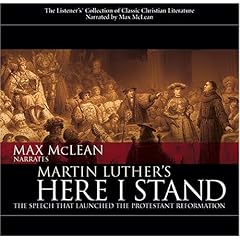
Martin Luther's Here I Stand (you can download at iTunes for $4.95; below is my review)


This is a pretty cool little audio book. Max McLean is the narrator and this is the least that he does. He presents the material in a very well done manner. He does more than just recite, he gives the impression that it is how Luther would have presented the speech if he were here today recounting this pivotal time.

Track Listing:
1. Introduction
2. The Road to Reformation
3. Luther’s Prayer
4. Here I Stand
5. Eck’s Response to Luther
6. Luther’s Final Response
7. Conclusion
8. Sources and closing comments

The CD starts off by giving some background to what is taking place, in not only the Roman Catholic church, but also in Luther's life. The leading up to the speech takes about 11 minutes, which not only covers the aforementioned material but also the prayer that Luther recited the night before he was to stand and defend his new found understanding of Scripture. Then the time comes to recite the speech that Martin Luther brought forth at the Diet of Worms as he began what we now see as one of the most pivotal times in all of church history.

McLean presents the entirety of not only the speech but even the questioning of Johann Eck, which is when Luther's famous words that ring so true to rebut the questioning being presented was brought forth:

My conscience is captive to the Word of God, I will not recant anything, for to go against conscience is neither honest nor safe. Here I stand, I cannot do otherwise. God help me. Amen.

I would highly recommend this audio book. The speech itself is very emotional to read, but to listen to it with such passion from Mr. McLean is something that I will enjoy for a long time. Link to buy (or you can buy at iTunes)

Read More......

Thursday, October 30, 2008

Best Books of 2008...so far


So far in 2008 I have read 25 books (2.5 books per month), with two more to be finished within the next day or two. I am not sure if this is a lot, not enough, or whatever. I thought I would give my personal list of the best books that I have read so far this year and then also some books I am looking forward to reading in the next few months. If you want to see all my book reviews, you can check out Contend Earnestly Books.

Best Theological Books of the Year:

1. The Reason for God, Timothy Keller

2. Jesus: Made in America, Stephen J. Nichols

3. God is the Gospel, John Piper

4. Vintage Jesus, Mark Driscoll and Gerry Breshears

5. Why We're Not Emergent, Kevin DeYoung and Ted Kluck

6. A Tale of Two Sons, John MacArthur

7. Simple Church, Thom Rainer & Eric Geiger

8. The Law and Its Fulfillment, Thomas R. Schreiner

9. Death by Suburb, David Goetz

10. Game Day for the Glory of God
, Stephen Altrogge


Best Secular Books I Read This Year:

1. Blood Meridian, Cormac McCarthy (book review coming soon)

2. The Road,
Cormac McCarthy (book review coming soon)

Books I Will Be Reading in the Next Quarter:


1. Apologetics to the Glory of God, John M. Frame

2. The God Who is There, Francis Schaeffer

3. Escape from Reason, Francis Schaeffer

4. He is There and He is Not Silent, Francis Schaeffer

5. Death by Love, Mark Driscoll and Gerry Breshears

6. Christ and Culture,
D.A. Carson

7. No Country for Old Men, Cormac McCarthy

8. Something by David James Duncan

If you would like to check out the different authors' blogs and sites they are listed below:

Timothy Keller

Stephen J. Nichols

John Piper


Mark Dricsoll

Gerry Breshears

Kevin DeYoung

Ted Kluck

John MacArthur


Thom Rainer


Eric Geiger

Thomas Schreiner


David Goetz

Stephen Altrogge

Cormac McCarthy

John M. Frame


Francis Schaeffer


D.A. Carson

David James Duncan


Read More......

Wednesday, October 29, 2008

A Pink Bunny, a Fat White Guy, a Headless Horseman and Jesus


With Halloween opening up the upcoming holiday season in U.S. and with all the Christians finding ways to attach tracts to candy like a drug dealer stuffing crack in the M & M's, I thought I would throw my two cents in with how a Christian should look at the major holidays in the United States.

It was funny because I was talking to a family in our church who adopted two 7 year old twins from Africa and they were trying to describe Halloween to them. They really didn't get it until they heard "free candy." That was all they needed to know to understand that this is probably the second best holiday behind Christmas. Where it's not candy only, but tons of presents that beat a "fun size" (good marketing) package of Skittles.

This got me thinking though on how utterly weird our holidays are in the United States. It also got me thinking about how we should all be ready to talk to our children about the holidays and what they mean. There are many critics and thoughts on the holiday season so I am going to try and balance these out and take a look at them as a whole.

Are the Holidays Biblical?

No. None of them are. What?! you might say. But when you take a look at the Bible, there is absolutely no precedence for any of the holidays that we celebrate. The closest one would be Easter, but even with Easter there are some issues. The purpose of holidays really comes down, in the simplest form, as a time of remembrance, celebration or just plain tradition. The reason I say that Easter is the closest to being biblical is because the only thing that we are told to remember is Jesus, through the death of Christ. You will see this is actually not found to happen through a holiday, or once a year, but through communion and done often.

For I received from the Lord what I also delivered to you, that the Lord Jesus on the night when he was betrayed took bread, and when he had given thanks, he broke it, and said, "This is my body which is for you. Do this in remembrance of me."In the same way also he took the cup, after supper, saying, "This cup is the new covenant in my blood. Do this, as often as you drink it, in remembrance of me." For as often as you eat this bread and drink the cup, you proclaim the Lord’s death until he comes.
1 Corinthians 11:23-26


So, when we talk about holidays being biblical or not, we have really missed the boat. Because none of them are biblical or outright mandated in any way through the Scriptures. I would actually argue that if you only celebrate the holidays and are "stale" throughout the rest of the year that you probably are not Christian at all, but you sure love those holidays.

Is It Wrong to Celebrate Holidays?

No. I am not a Jehovah's Witness. It is pretty funny to think about our holidays though. We have one, where a huge pink bunny hides crap around your yard and then sneaks into your child's room and leaves a basket that includes a large chocolate depiction of the bunny so you can eat him. If that is not strange, I am not sure what is. Oh wait...we also have this fat guy. Think of this. Every year you take your kid to sit on this fat guy's lap, take a picture and then give him permission to break into your house, eat your cookies and drink your milk and then leave presents. Usually, if a big fat white guy breaks into my house I shoot him, but in this case we welcome it. The one that is coming up on Friday is no less strange. We dress our kids up like strange heroes, tell them to knock on a strangers door, say "trick or treat" (hopefully they get treat, because if they get trick, I will have to call the police) and expect that person to hand our kids candy. Seriously, what is with all this non sense? It is really hilarious when you think of it.

People like to say that these things are wrong, especially Halloween, because of their root reasons that they started. The problem with this is that Christmas in general has some very pagan roots and the term Easter comes from a pagan goddess. So, to pick and choose gets very dangerous overall. With all this said, I believe it is fine to celebrate these holidays as Christians, and like most things, it all depends on the focus.

How Should We Celebrate These Holidays?

It is all about the focus and attitude of the parents involved. I personally think all these holidays are great times to talk to others about Jesus or to just have some great fellowship with others. As far as Halloween I don't know anyone who can't wait to skin a goat for Satan on this holiday, so I am not too worried about it's paganism or Satanism. If I was worried about Halloween, I should also be worried about Christmas and Easter for the above mentioned reasons.

In my house for Christmas we have fun with Santa and stuff, but we have told our kid that Santa isn't real but is just for fun and we focus more on Christ and His birth. We use the time to show the focus of giving as God gave us his Son. Is there anything wrong with the fat guy in the red suit? There could be if he is the focus, but there is nothing inherently wrong with having fun with it. And please...slow down with getting mad about people saying "Happy Holidays." The holidays in the U.S. has long left out Christ, so people saying "Happy Holidays" is just showing what happened many years ago with Christ and Christmas. It isn't a big deal. Chill out. And by the way, it isn't wrong to call it X-Mas. The "X" is "Chi" the first letter of Christos (Χριστóς), Greek for "anointed"and is in reference to the Ichthus.

As far as Easter we do the same thing. Christians like to use the term "Resurrection Sunday" which is fine. Seems more like a protest against non-Christians than just an actual statement most of the time I hear it. With my family we simply talk to our sons about how we don't celebrate Easter once a year, but all the time. We talk to them about the significance of this time, but we make sure that they understand thinking about Jesus' crucifixion and resurrection should be a daily experience. As far as the big bunny, we still do Easter egg hunts and give him a basket. Why? Because it is fun, that's why. Why do you eat a Turkey on Thanksgiving? Because it is good to eat, that's why.

Halloween is no different than other holidays. Personally I have abstained from buying a goat and sacrificing it to Lucifer because that seems a little over the top. But, we do go around and collect free candy from our neighbors. Why? Because it's fun. That's why. Unless you are teaching your children about paganism and the worship of demons, Halloween is harmless. Take the time to meet your neighbors and have fun with it. Don't be the shut ins who yell from inside your dark house, "If you celebrate Halloween you are going go to hell and celebrate it forever with your master!" Usually those people need a straight jacket and a good egging from the neighbor kids. Why? Because that is funny. That's why.

We all know that every holiday that comes around in the U.S. is really for consumerism. That's really it. It is our job, like most times, to bring the focus in on Christ and his glory. We should always be doing this. We should always be looking for ways to show our children and our culture the greatness of God. Our holidays in the U.S. is just another way to be with our communities and show them who Christ is. So, make sure you seek Christ and his ways for these times and ask him to show you the balance that is correct for your household. Personally, I don't think that abstention is the answer to these holidays, just a correct world view.

Have a great Halloween and know that if your house is dark and your not handing out candy, I am going to supply the neighbor kids with eggs. :)


Read More......

Tuesday, October 28, 2008

Politics, Jesus and the USA


I am confused. I usually am, but hide it well. This is probably going to be my last post on politics for a little while as it gets kind of tiring to defend myself to everyone. Here is the reason. I am not going to vote...again...but I do have some thoughts on politics and Jesus as a whole. I want to just see if I can get people to think about why they are voting for who they are voting for. I also want to try and learn through this process from others who are far more mature than I am on this issue. I think in the end it might help give a glimpse into each side so that more fruitful conversations can happen. I could be wrong though, time will tell.

What Does Voting for the "Lesser of Two Evils Mean?"


From many conservatives this is the quote I get when they tell me why they are voting for who they are voting for. But, which evils are you talking about?
Killing Babies vs Killing Innocent Civilians

Now, I am against abortion in all forms. But, we also have a government right now that is involved in a "war" where we don't need to be. So, being that I believe this is the case, we are then killing innocent people for no purpose. People will say, "well innocent people aren't being killed. They aren't innocent if they are shooting at our troops." Let me ask you. If you had troops coming in and taking over your towns from another country and they were entering your house, would you try and protect your family? I think so, or hope so. I am not blaming the troops here, but just saying that my reaction would be a lot like those who are nervously reacting to the U.S. troops in their towns and villages. I "believe" in war. But, I believe in war when it is necessary. I don't believe this "war" is a necessary one at this point. Please don't see this as not supporting the troops or coming down on them, but I blame the President and those in charge of making these decisions. So, what is the difference with killing innocent babies and innocent civilians? Isn't a life a life?

This is why McCain scares me. He seems to be ready to go to war for any reason and stay in Iraq for however long it takes to "win the war in Iraq." The other part of this equation that many conservatives don't bring up is the fact that McCain BELIEVES IN ABORTION! So, the abortion issue is a dead one for this election. Killing babies is killing babies, no matter the process that takes place. So, which one is the lesser of the two evils here? Obama or McCain? I honestly can't decide. I don't know. They both scare me here.

Greed vs Socialism

This is another tough one. One presidential candidate is part of the new Republican party that seems to give extreme tax breaks to the wealthy that go further than mere trickle down economics. The other seems to believe in a quasi socialism government that takes money from the rich and spreads it around to the poor. Although I do believe in trickle down economics, I believe that the Republican party is using this as an excuse to give more tax breaks to the uber rich than need be. This starts to support the sin of greed and is a very deep evil that Jesus speaks against more than he speaks on heaven and hell combined.

Quasi socialism on the other hand is actually directly against the Bible as well. God's nation had a welfare system set up where the poor had to work for their "money" and did not receive it by mere hand outs (unless you were a leper at the city gate, but even many still just passed by in disgust). What we find in the Bible is a welfare system set up where the rich weren't allowed to glean the corners of their fields but left it for the poor to come and glean. Notice though who is doing the gleaning. It wasn't the workers of the rich or the rich themselves, but it was the poor who came and gleaned for themselves (we see this play out in the book of Ruth). All through the Proverbs we see that if you don't work, you will be poor. That the fool is lazy, the fool doesn't work, etc. Even Paul tells us that he who does not provide for his household is worse than an unbeliever. Socialism and the current welfare system fly in the face of the clear teachings in Scripture. Are there exceptions to the rule? Of course. We have those that are disabled, have degenerate diseases, etc. But we are talking about the poor as a whole here. I would encourage you to look at this video for some helpful thoughts on this issue.

So, which of these two are the lesser of the two evils? Greed or Socialism? I can't decide. They are both evil.

The next two deal with issues that I believe have more to do with a Theocracy than a democracy. Meaning, if we were a nation truly under the rule of God alone, these next two would be bigger issues, but the facts will show that we are not a Christian nation.

Divorce or Gay Marriage

I am going to really hammer something here. I don't agree with either of these. Sure, the Bible gives us two ways that a believer can divorce, and only two. One, an unfaithful spouse and the other is a non-believer who wishes to leave the believing spouse. That is it. And these are last resorts. I have told my wife that if she cheats on me, I will not divorce her. That is my decision and she has told me the same. But, my point here is that gay marriage is not what is going to kill the sanctity of marriage, but "Christians" that get divorced (unbiblically) are. Christians who say "I do" and become one flesh and then decide to divorce are killing the understanding of what it means to have a Christian marriage under the authority of God. Statistics tell us that Christians have MORE chance to get divorced than unbelievers. So, you tell me who is killing the sanctity of marriage? We should expect the unbeliever to not follow the way of the Scriptures. We should expect them to want and desire to rebel against the word of God. We should expect them to want to marry the same sex, have adulterous relationships, have more than one partner, to live with one another before marriage, etc. But, when we, as Christians, are doing the same, we need to figure out what is going on with the sanctity of marriage within the church before we try and regulate the non-Christian. Plank in eye vs speck in another's comes to mind. I truly believe that the divorce rate among Christians is far more insulting to God's institution of marriage than non-Christian gay marriage.

If we were a Christian nation, we should ban all unbiblical divorces. But, we are not a Christian nation, therefore it becomes harder to regulate. I just think we really need to figure out what is going on in our own house before we yell at our neighbors.

Freedom of Religion

If we were a Christian nation, the most abhorrent thing you could do is give way to freedom of religion. This might surprise some, but it is true. When did God ever say it was okay to allow idolatry among his people? This actually is the worst thing that the nation of Israel could do. If we were a Christian nation, then we should abolish the thought of freedom of religion. Every time someone chooses some other god (demon) than Jehovah God, that is idolatry. This is, by far, the worst crime happening in America. Never would God approve of worshiping idols in his own nation, by his own people. This is one of the reasons that I do not believe that America is a Christian nation, nor was it ever a Christian nation. It might have been built on some Christian ideals, but "close" doesn't count when speaking of our God.

Freedom of choice, when it comes to religion, is the main reason why I wonder why we allow non-Christians to choose their idols, but not choose how they live the rest of their lives? This confuses me. If we were a Christian nation, my views would completely change. But we aren't.

Pagan nations in the Bible had unbridled sex to their gods (USA does this through many facets), sacrificed their babies to their gods (USA does this through abortion), allowed polytheism (USA does this), praised the gods for their wealth (USA does this through greed and consumerism).

So, you be the judge. Is the USA a pagan nation or a Christian nation?

How do you choose between the least of the two evils? You are going to choose between two candidates where they feed greed, socialism, killing of innocent babies and civilians, devout liars, freedom of religion, unbiblical divorce, gay marriage and the list goes on. This is an honest question. I am just curious on the reasons that people vote with this thought process. It is not a loaded question, but one that I am trying to find answers to.

This is the reason that I have decided to not vote. Neither candidate is even close to my personal convictions on the issues. McCain is no closer than Obama.


Read More......

Monday, October 27, 2008

New Christianity?


Have you noticed this happening? I am in my early 30's and what I have found with a lot of people that I went to college with and also those that are young in the church is this new "thinking Christian" in the 21st century. What it seems people have gotten tired of are those "Christians" who when asked a tough questions by others just grin like Bob Ross and softly say, "Just have faith" and then go about licking their glue stick.

It seems as though the Christian has gotten tired of being ran over by the atheist and the postmodern who pose great questions of the Christian faith. They ask tough questions, that I might add, are completely valid. The problem with what I found throughout the 90's is that most, when asked tough questions just stated, "the righteous shall live by faith" and then they moved on. What they forgot is when Peter states,

"but sanctify Christ as Lord in your hearts, always being ready to make a defense to everyone who asks you to give an account for the hope that is in you, yet with gentleness and reverence;
1 Peter 3:15


Instead of a defense, most Christians pointed to their WWJD bracelet and "My Boss is a Jewish Carpenter" bumper sticker and called it a "defense." This is lame. This was lame and always will be lame. The term defense that is found in 1 Peter 3:15 is actually court room language of providing evidence to show that the truth in you is actually true. It is evidence that would convince a jury that you are right. Instead, what we have found is the "Jesus freak" with a painted smile that should be put in a straight jacket and laughed out of the court room.

What is interesting is the turn of events that is happening within the Christian community. It seems as though Christians are tired of getting ran over by thoughtful and insightful atheists and other religious leaders. When they stopped grinning and licking their glue stick they found that the person asking the question was still standing there trying to understand why you chose Jesus over Ghandi. Now, the Christian isn't laughing, but are now posing the same questions, looking for answers. Yes, there are still those plastic Christians who don't know jack about those around them that are begging to be answered. But, what I have found is that more and more Christians are having personal revivals of understanding within the Christian faith. They are seeing that the Christian faith isn't another stupid religion, but one that has evidence, one that involves thinking, logic and deep historical roots that is found little among other religions or atheistic thought.

It seems we are on the edge of a New Christian. I say "new" with a little smirk because it isn't new, but it is vintage. It is old school. It is what Christianity was always supposed to be about. Christianity wasn't supposed to be t-shirt theology, but deep rooted understanding about life and culture and eternal answers to what is happening around us, all for our Creator's glory.

So, what is now happening with this "new" Christian? They are finding that the best books are not the new ones, like "The Shack" with some lame depiction of God as a black woman, but they are finding that the best books to read about the Christian faith come from the early church fathers, the reformers and the puritans. Those who had to defend the faith in the most vital times in history. Those whose heads always had a bounty. Those who had to show others why the Christian faith was worth dying for. Those who saw the communities around them falling into paganism and wanted revival of Christian thought. Those who saw families losing a child every year to a new plague, or a new disease. Those who had to give answers at funerals of why there was a plague and it seemed like God was not there.

I believe the reason that we went to sleep for so long in this country was because of its wealth and protection. We do not find our children dying of malaria. We do not find our churches being ransacked to kill the pastor and those in attendance. We do not have fear when we read our Bibles in public. When these things don't happen the people get comfortable. When we get comfortable we become complacent. When we become complacent, we buy t-shirts and bracelets that have a better testimony than we do. And when this happens when we are asked questions, instead of saying, "I don't know" we grin and provide a life verse that speaks about inner change and faith that no one sees besides on our cars. Aliens must think at times that our cars are the ones that are saved and not us.

Why now though? Why are we starting to see the change in Christian thought to more of a vintage thought? I would presume it is actually because of the world wide media being seen so closely. Via the world wide web, the global economy, etc. everything in the world is at our finger tips. We have now had some fear with 9/11 and the massive attacks around the world. More questions are starting to be posed to us, and instead of grinning and bearing it, we actually want answers ourselves. We want more than a bracelet, we want a faith worth dying for.

We are tired of looking like idiots to others. In this United States, Christianity is not the only religion, but we are finding that instead of India only having Buddhists and Hindus, that our neighbors are Buddhists and Hindus. That instead of the Middle East having all the Muslims that next to our churches are Mosques. When this happens, you cannot shrug it off as that is just "them" because it is now "us" in the United States. When a Christian says something that is not true about another religion, the person within that religion is right there to correct them...to their face.

Because of this, the "New Christians" are begging for answers. And guess what? They are easily finding it. Christianity is not built as a religion of straw, but a religion with the most secure foundation found: THE Creator of all things. The only omniscient, omnipresent, omnipotent God. With this, the "New Christian" wants to represent HIM well, instead of being a feeble example.

Although we haven't seen this happen thoroughly yet, it seems like it is happening right in front of our eyes and I am excited to see it work itself out. I am thankful for men like Gresham Machen, Francis Schaeffer, Ravi Zacharias, Tim Keller and David Wells. These men have helped and are helping our "New Christians" find help in time of need. These men have shown and are showing the Christian that the Christian faith is a faith with evidence, not a blind faith like so many claim.

I would encourage everyone who is a Christian to make sure that you are ready to give a defense to those who question. Don't be afraid to say "I don't know" or "I struggle with that too." Be honest with people because they see through your crappy answers. Go find the answers though. Go search and try and show the person posing the question that you aren't trying to win a debate, but are trying to show them the deep impact these questions and answers have on their soul.

May we all understand that the atheist or the questioner of Christianity desires these answers and is not merely asking to stump you. We know this because God tells us that he has set eternity in every man's heart (Ecclesiastes 3:11).

How about we put away our t-shirts and really lame bracelets and actually pick up a book that will depict our glorious God and then share that with those who desire to know the hope that lies within us. Because your boss is not a Jewish Carpenter, but he is the Lord of Glory.


Read More......
Related Posts with Thumbnails