Contend Earnestly

Sunday, November 18, 2007

Atonement Debate: Turretinfan Response


Introduction

With respect, I think that Mr. McBee (aka "SDM") seems to have misidentified the point I was trying to make. Perhaps this is because I was too brief. I certainly do not believe, and do not wish to suggest, that Mr. McBee intentionally misrepresented me. On the other hand, each time Mr. McBee wrote "Turretinfan's position is," I think he missed the position. Allow me to elaborate.

The Point Restated

Christ died for the express purpose of saving the elect. The point of citing John 3:16 was to point out the third phrase, "ινα πας ο πιστευων εις αυτον μη αποληται," that is in Latin "ut omnis qui credit in eum non pereat" fairly literally rendered "so-that-would all the believing-ones (in him) not perish," more casually "so that all who believe in him would not perish" or as the KJV so memorably translates it "that whosoever believeth in him should not perish."


The rest, the question of what does the word kosmos mean, and so forth is all secondary. It is important, but it is secondary. The first thing to understand from the phrase is that God is explaining purpose. The phrase is a so-called "hina" phrase, called because it is introduced by "ινα" (typically pronounced "hina") as can be seen above.

In this case, the hina phrase is connected to and is explained by the preceding phrase. The preceding phrase is "ωστε τον υιον αυτου τον μονογενη εδωκεν" in Latin "ut Filium suum unigenitum daret" fairly literally rendered "so (the-[one-who-is]) son his (the-[one-who-is]) onlybegotton he-gave" or more casually "so he gave up his onlybegotten son," or as the KJV so memorably translates it "that he gave his only begotten Son."

In other words, grammatically, the feature of all the believers being saved is linked to the feature of God giving His only begotten Son. From the structure of the sentence we can see that the reason why God gave his Son, was to save all the believers.

Finally, of course, the "hoste" (ωστε) similarly connects to the phrase that goes before it. The phrase before it is "ουτως γαρ ηγαπησεν ο θεος τον κοσμον" which in Latin is "sic enim dilexit Deus mundum" and can be fairly literally translated "in-this-way for he-loved (the) God (the) world" or more casually "for God loved the world thus" or as the KJV so memorably translates it "For God so loved the world."

This starts the thought, while showing that the thought is providing an illustration of the thought that precedes it. The "For . God loved the world" connects to the preceding thought, while the "thus" tells us that an explanation follows. As seen above, this explanation is two-fold. First, God gave his onlybegotten Son. And Second, God gave him for the purpose of saving all the believers.

It's not particularly important to my argument to define the word "world." Does it mean "the world of the elect" as some have said, or just "men" or perhaps "the natural/created order"? It doesn't particularly matter for the argument that I'm making positively.

The point is that the verse makes the gift's purpose clear: to save believers. My point is that this verse is evidence of the fact that such was Christ's purpose. His purpose always to save the believers, all of the believers, and - while the verse does not say so explicitly - only the believers.

If we had only John 3:17's comment: "but that the world through him might be saved," the question would be open, and we'd have to really dig in to figure out what "world" means. Not so with verse 16. Verse 16 is specific. And we have verse 18 as well, which explains that the "believers-in-him" are not condemned, whereas the "unbelievers-in-him" are already condemned.

Now, I would not take the position "God so loved the world, that is, the elect of the world, that He sent His Son." Why not? There are two reasons: (1) it uses the word "world" equivocally, and (2) the point of the verse is simply: God so loved the kosmos, that He sent His Son to save the elect.

Ok, but what does "Kosmos" mean?

SDM noted that kosmos has a variety of meaning. I would respectfully disagree with one of his claims. He cited Mark 16:15 as being a case of when kosmos means "all of humanity." Mark 16:15 uses kosmos to mean the actual earth (geo-politically). In fact, with respect, I think SDM would be hard pressed in any of the about 150 verses (or about 180 uses) that use the word kosmos in the New Testament to come up with even one that clearly uses the word to mean all humanity, and not simply the actual world, or the natural/created (sometimes considered as fallen) order generally. Even if SDM could come up with a few such examples, I think SDM would have to admit that the dominant usage in the New Testament and in other ancient philosophical material is of the actual world or the created/natural order.


In other words, I would respectfully submit that using the word as SDM does is mostly based on a philosophical presupposition that SDM brings with him to the text, not based on something in the word itself.

I would expand on what SDM said. In Scripture, kosmos ordinarily is a broad term that conveys a sense of expansiveness. It ordinarily does not carry an exhaustive sense. We use "all" this way frequently (and "world" sometimes) in common parlance. It's a form of hyperbole. The statement: "He has traveled through the whole world (or all over the world)," means he is a globe-trotter, not that there is no stone his soles have not touched. This too will be significant as we proceed.

SDM, however, wrote: "Turretinfan's position is that this term, world or "kosmos", means "elect"." That's not quite an accurate representation. I don't take the position that the word means that, but I think that the word - in context - does refer primarily to the elect as a global group. In other words, the "world" contrasted with just the Jews like Nicodemeus the Pharisee to whom Jesus was speaking. We'll see how this is true, as we proceed. But this misunderstanding (I assume it is not an intentional straw man), leads to most of SDM's counter-arguments being irrelevant.

Unraveling SDM's Counter-Presentation

SDM's position is fairly clear: to SDM "the world" is composed of two groups: those who will believe and those who won't. SDM states this position, but I think if we examine his explanation closely we'll see he hasn't actually establish this position with exegesis.

SDM indicates that in his view the verse starts by treating one group, each and every person, in the phrase "God so loved the world." SDM claims that John then turns to another group "those believing will not perish." SDM correctly notes that this term is implies that there is another group, the unbelievers who will perish. SDM then asserts that those two groups make up the original group of the world.

Based on those premises, SDM concludes that to make "the world" = "the elect" would create a problem, because some of the elect would be unbelievers that perish. The problem, of course, is not in the logic, but in the premises. Specifically, the problem is in assuming that "the believing ones who will not perish" i.e. the elect, is intended to be a sub-category of "world."

From the grammatical/exegetical analysis we saw above, there is no particular need to make the believing ones a sub-category of the "world." In fact, it would be more natural to assume that "the believing ones" is a more precise way of expressing the same thing as what is intended by "the world." Alternatively, we may simply conclude that "world" is a reference to the Creation generally (the natural/created order), and that the phrase about God's love for what he made is to be understood specifically by his expression of that love: giving his Son for the elect.

To borrow SDM's Texas analogy, it would be a bit like saying: "I love Texas; so, I moved to Texas and married a lass from Galveston." Such a comment would not suggest that the speaker plans to play the field with other Texan women, or that his love for Texan women generally is equal to that of his bride. Furthermore, if the same man said that "I didn't come to Texas to visit, but to live there," no one would suppose that the speaker meant that he was going to live in every town in Texas, or that he might not visit Dallas or Houston from time to time, but would understand that he lives in Texas by living in a particular town in Texas, and is wed to Texas by his marriage to the particular Galveston gal, not to every woman who lives there. We also wouldn't assume from his "I love Texas," that he necessarily likes the desert, the beach, the Rio Grande river, Dallas Fort-Worth airport, or Dr. Pepper, whether or not those are a part of Texas. We let people speak in general terms, and we should give Scripture the same flexibility.

Yes, but what about John 12:47?

SDM appeals to John 12:47, which - of course - is not part of the immediate context. Nevertheless, it uses some similar terms, so we should examine it, as well as the other corresponding Johanine passages.

John 12:47 has its own context, which I'll show below:


46I am come a light into the world, that whosoever believeth on me should not abide in darkness. 47And if any man hear my words, and believe not, I judge him not: for I came not to judge the world, but to save the world. 48He that rejecteth me, and receiveth not my words, hath one that judgeth him: the word that I have spoken, the same shall judge him in the last day. 49For I have not spoken of myself; but the Father which sent me, he gave me a commandment, what I should say, and what I should speak. 50And I know that his commandment is life everlasting: whatsoever I speak therefore, even as the Father said unto me, so I speak.
John 12:46-50


It seems to me that if "the world" just means the created order generally, and not all men exhaustively, then the passage makes more sense. Specifically, verse 46 would seem to be a bit odd, for it appears to refer to Christ's incarnation: his coming into the world, not his coming into the hearts of each and every person.

On the other hand, if we view the word "world" the same way in verse 46 and verse 47, then Christ's statement is easily understood: he's here to save the created order not to judge it. That is to say, He's here as a Savior, not a Judge. He immediately points out, though, that his words do judge those who reject them, because he speaks the words of the Father who sent him, namely the commandments of eternal life.

And John 12:47/John 3:17 is not the only place to find this concept. The same concept also can be found in the fist chapter of John:

9That was the true Light, which lighteth every man that cometh into the world. 10He was in the world, and the world was made by him, and the world knew him not. 11He came unto his own, and his own received him not. 12But as many as received him, to them gave he power to become the sons of God, even to them that believe on his name: 13Which were born, not of blood, nor of the will of the flesh, nor of the will of man, but of God. 14And the Word was made flesh, and dwelt among us, (and we beheld his glory, the glory as of the only begotten of the Father,) full of grace and truth.

John 1:9-14

Now, unlike John 12, John 1 is the preceding context (even if somewhat removed) of John 3. A reader who is reading John's gospel (or hearing it read) will have heard this by the time he gets to John 3. How does John 1 use the term "world." It uses it in the sense of the created order, but it also uses it as a broader term to another group: "his own," which the reader will soon discover are the Jews.

Indeed, we see this same theme in John 3:10-11, repeated just before the verses we are discussing:

John 3:10-11

10Jesus answered and said unto him, Art thou a master of Israel, and knowest not these things? 11Verily, verily, I say unto thee, We speak that we do know, and testify that we have seen; and ye receive not our witness.


Notice the switch in address from simply Nicodemus (thou . knowest not) to Israel generally or especially the Jewish leaders (ye receive not). "Thou" is singular, but "ye" is plural. Thus, as promised above, we can see that the use of the word "world" as a broad term to indicate more-than-just-Jewish-people is both supported by the precedent set in chapter 1, and the confirming context in verses 10-11.

It's worth pointing out that Jesus makes similar claims to be the light of the world and the Savior of those who follow him (the light), several times before John 12:

John 8:12 Then spake Jesus again unto them, saying, I am the light of the world: he that followeth me shall not walk in darkness, but shall have the light of life.

(the precipitates an argument with the Pharisees over whether this is just Jesus' say-so, which Jesus denies, saying that the Father bears witness to the truth of his testimony, but then turns the tables on them, explaining why they do not understand and follow him, that is to say, why they do not see the light, compare Paul's comments in 2 Corinthians 4:4)

Or again:

As long as I am in the world, I am the light of the world.

John 9:5
(this context is pretty interesting, because Jesus demonstrates how people see the light by curing the blindness of the man born blind, which is a picture of our spiritual blindness before regeneration)

And again:

Jesus answered, Are there not twelve hours in the day? If any man walk in the day, he stumbleth not, because he seeth the light of this world.
John 11:9


(this context is interesting too, because Jesus immediately goes and raises Lazarus from the dead, which is another picture of our spiritual deadness before regeneration)

So also, even if we simply go beyond John 3:18, and get the further explanation in the subsequent verses, we see:

19And this is the condemnation, that light is come into the world, and men loved darkness rather than light, because their deeds were evil. 20For every one that doeth evil hateth the light, neither cometh to the light, lest his deeds should be reproved. 21But he that doeth truth cometh to the light, that his deeds may be made manifest, that they are wrought in God.
John 3:19-21


In other words, the light shining in the world condemns (demonstrates the guilt of) those who hide, but justifies (demonstrates the righteousness of) those who come. It's an amazing light: first we see our sin, then we see our Savior, and then we come to God in our Savior's righteousness.

Christ is that light. He came to open the eyes of the spiritually blind, to raise the spiritually dead, and to save them from their sins through faith in himself. He came to save them, he did not come to save the reprobate.

Yes, but what about the Brass Serpent?

The serpent is not quite the analogy that SDM was looking for. Let's look quickly at the entire original account, since it is short:


4And they journeyed from mount Hor by the way of the Red sea, to compass the land of Edom: and the soul of the people was much discouraged because of the way. 5And the people spake against God, and against Moses, Wherefore have ye brought us up out of Egypt to die in the wilderness? for there is no bread, neither is there any water; and our soul loatheth this light bread. 6And the LORD sent fiery serpents among the people, and they bit the people; and much people of Israel died. 7Therefore the people came to Moses, and said, We have sinned, for we have spoken against the LORD, and against thee; pray unto the LORD, that he take away the serpents from us. And Moses prayed for the people. 8And the LORD said unto Moses, Make thee a fiery serpent, and set it upon a pole: and it shall come to pass, that every one that is bitten, when he looketh upon it, shall live. 9And Moses made a serpent of brass, and put it upon a pole, and it came to pass, that if a serpent had bitten any man, when he beheld the serpent of brass, he lived.
Numbers 21:4-9

SDM claims that this is "a direct parallel . [if] you looked, you were saved, if you didn't look, you died." Actually, though, the original passage doesn't make any mention of anyone not looking and dying. That's not really the parallel at all.

The parallel is two-fold. First, like the serpent, Jesus will be crucified ("as Moses lifted up the serpent . so must the Son of man be lifted up" - see also John 8:28 and John 12:32-33). Second, the point is that in crucifixion, Christ will save those he is intended to save.

I think SDM misreads Numbers 21:8. That verse says: "every one that is bitten, when he looks on it, shall live." And then the next verse explains, "If a serpent had bitten any man, when he beheld the serpent of brass, he lived." Now, there clearly are some translational differences between SDM's and mine, but the point of the passage is actually that God is providing salvation to the people who repented of their grumbling against God and prayed to Him. The sense is "everyone who is bitten will live, when he sees the brass serpent," and "when anyone got bit by a serpent, he looked to the brass serpent, and lived." There's really nothing here about a foolish group of Israelites that refused to look at the brass serpent, and consequently died.

Instead, the point is that for those upon whom God had mercy, he provided a serpent, and they looked (everyone and "any man" "if a serpent had bitten" him) and lived.

There's also no discussion about the serpent being a provision for anyone's idolatry (after all, they were being punished for grumbling not idolatry), nor being a provision either generally for a particular category of sin, or for the specific sins of the people. Instead, the serpent pictured the punishment, not the crime. Even so, Christ died for our sins, on the cross. On the cross he was punished in our place. Our sins were nailed to the cross, and taken away. We can see from the rest of the law, that atonement was not simply made for categories of sins, but I fear that such a discussion will get us away from the text we are currently debating, and this post is long enough as it is.

Yes, but what about Calvin, Davenport, Ryle, and Dabney?

For now, I'm going to stick with what the text of Scripture says, not the meta-debate about whether Calvin (or the others) was a Calvinist as defined by Article 21 of Belgic Confession; the Second Main Pint of Doctrine of the Canons of Dordt; or Chapter 8, paragraph 8, of both the London Baptist Confession of 1689 and the Westminster Confession of Faith of 1646.

The point is that God provided salvation for his people: that is the gem of his love for the Creation. Thus, Christ is the savior of Creation, or to put it more specifically, the elect. That's what Scripture says, and that's what we believe.


Read More......

Friday, November 16, 2007

John Calvin on John 3:16

I figured while we wait I would go ahead and post Calvin's commentary on John 3:14-17. I think you will find some of the things said here is the same that we are purporting to all.

14. And as Moses lifted up the serpent. He explains more clearly why he said that it is he alone to whom heaven is opened; namely, that he brings to heaven all who are only willing to follow him as their guide; for he testifies that he will be openly and publicly manifested to all, that he may diffuse his power over men of every class. 60 To be lifted up means to be placed in a lofty and elevated situation, so as to be exhibited to the view of all. This was done by the preaching of the Gospel; for the explanation of it which some give, as referring to the cross, neither agrees with the context nor is applicable to the present subject. The simple meaning of the words therefore is, that, by the preaching of the Gospel, Christ was to be raised on high, like a standard to which the eyes of all would be directed, as Isaiah had foretold, (Isaiah 2:2.) As a type of this lifting up, he refers to the brazen serpent, which was erected by Moses, the sight of which was a salutary remedy to those who had been wounded by the deadly bite of serpents. The history of that transaction is well known, and is detailed in Numbers 21:9. Christ introduces it in this passage, in order to show that he must be placed before the eyes of all by the doctrine of the Gospel, that all who look at him by faith may obtain salvation. Hence it ought to be inferred that Christ is clearly exhibited to us in the Gospel, in order that no man may complain of obscurity; and that this manifestation is common to all, and that faith has its own look, by which it perceives him as present; as Paul tells us that a lively portrait of Christ with his cross is exhibited, when he is truly preached, (Galatians 3:1.)


The metaphor is not inappropriate or far-fetched. As it was only the outward appearance of a serpent, but contained nothing within that was pestilential or venomous, so Christ clothed himself with the form of sinful flesh, which yet was pure and free from all sin, that he might cure in us the deadly wound of sin. It was not in vain that, when the Jews were wounded by serpents, the Lord formerly prepared this kind of antidote; and it tended to confirm the discourse which Christ delivered. For when he saw that he was despised as a mean and unknown person, he could produce nothing more appropriate than the lifting up of the serpent, to tell them, that they ought not to think it strange, if, contrary to the expectation of men, he were lifted up on high from the very lowest condition, because this had already been shadowed out under the Law by the type of the serpent.

A question now arises: Does Christ compare himself to the serpent, because there is some resemblance; or, does he pronounce it to have been a sacrament, as the Manna was? For though the Manna was bodily food, intended for present use, yet Paul testifies that it was a spiritual mystery, (1 Corinthians 10:3.) I am led to think that this was also the case with the brazen serpent, both by this passage, and the fact of its being preserved for the future, until the superstition of the people had converted it into an idol, (2 Kings 18:4.) If any one form a different opinion, I do not debate the point with him.

16. For God so loved the world. Christ opens up the first cause, and, as it were, the source of our salvation, and he does so, that no doubt may remain; for our minds cannot find calm repose, until we arrive at the unmerited love of God. As the whole matter of our salvation must not be sought any where else than in Christ, so we must see whence Christ came to us, and why he was offered to be our Savior. Both points are distinctly stated to us: namely, that faith in Christ brings life to all, and that Christ brought life, because the Heavenly Father loves the human race, and wishes that they should not perish. And this order ought to be carefully observed; for such is the wicked ambition which belongs to our nature, that when the question relates to the origin of our salvation, we quickly form diabolical imaginations about our own merits. Accordingly, we imagine that God is reconciled to us, because he has reckoned us worthy that he should look upon us. But Scripture everywhere extols his pure and unmingled mercy, which sets aside all merits.

And the words of Christ mean nothing else, when he declares the cause to be in the love of God. For if we wish to ascend higher, the Spirit shuts the door by the mouth of Paul, when he informs us that this love was founded on the purpose of his will, (Ephesians 1:5.) And, indeed, it is very evident that Christ spoke in this manner, in order to draw away men from the contemplation of themselves to look at the mercy of God alone. Nor does he say that God was moved to deliver us, because he perceived in us something that was worthy of so excellent a blessing, but ascribes the glory of our deliverance entirely to his love. And this is still more clear from what follows; for he adds, that God gave his Son to men, that they may not perish. Hence it follows that, until Christ bestow his aid in rescuing the lost, all are destined to eternal destruction. This is also demonstrated by Paul from a consideration of the time;

for he loved us while we were still enemies by sin, (Romans 5:8, 10.)

And, indeed, where sin reigns, we shall find nothing but the wrath of God, which draws death along with it. It is mercy, therefore, that reconciles us to God, that he may likewise restore us to life.

This mode of expression, however, may appear to be at variance with many passages of Scripture, which lay in Christ the first foundation of the love of God to us, and show that out of him we are hated by God. But we ought to remember — what I have already stated — that the secret love with which the Heavenly Father loved us in himself is higher than all other causes; but that the grace which he wishes to be made known to us, and by which we are excited to the hope of salvation, commences with the reconciliation which was procured through Christ. For since he necessarily hates sin, how shall we believe that we are loved by him, until atonement has been made for those sins on account of which he is justly offended at us? Thus, the love of Christ must intervene for the purpose of reconciling God to us, before we have any experience of his fatherly kindness. But as we are first informed that God, because he loved us, gave his Son to die for us, so it is immediately added, that it is Christ alone on whom, strictly speaking, faith ought to look.

He gave his only-begotten Son, that whosoever believeth on him may not perish. This, he says, is the proper look of faith, to be fixed on Christ, in whom it beholds the breast of God filled with love: this is a firm and enduring support, to rely on the death of Christ as the only pledge of that love. The word only-begotten is emphatic, (ἐμφατικὸ ν) to magnify the fervor of the love of God towards us. For as men are not easily convinced that God loves them, in order to remove all doubt, he has expressly stated that we are so very dear to God that, on our account, he did not even spare his only-begotten Son. Since, therefore, God has most abundantly testified his love towards us, whoever is not satisfied with this testimony, and still remains in doubt, offers a high insult to Christ, as if he had been an ordinary man given up at random to death. But we ought rather to consider that, in proportion to the estimation in which God holds his only-begotten Son, so much the more precious did our salvation appear to him, for the ransom of which he chose that his only-begotten Son should die. To this name Christ has a right, because he is by nature the only Son of God; and he communicates this honor to us by adoption, when we are engrafted into his body.

That whosoever believeth on him may not perish. It is a remarkable commendation of faith, that it frees us from everlasting destruction. For he intended expressly to state that, though we appear to have been born to death, undoubted deliverance is offered to us by the faith of Christ; and, therefore, that we ought not to fear death, which otherwise hangs over us. And he has employed the universal term whosoever, both to invite all indiscriminately to partake of life, and to cut off every excuse from unbelievers. Such is also the import of the term World, which he formerly used; for though nothing will be found in the world that is worthy of the favor of God, yet he shows himself to be reconciled to the whole world, when he invites all men without exception to the faith of Christ, which is nothing else than an entrance into life.

Let us remember, on the other hand, that while life is promised universally to all who believe in Christ, still faith is not common to all. For Christ is made known and held out to the view of all, but the elect alone are they whose eyes God opens, that they may seek him by faith. Here, too, is displayed a wonderful effect of faith; for by it we receive Christ such as he is given to us by the Father — that is, as having freed us from the condemnation of eternal death, and made us heirs of eternal life, because, by the sacrifice of his death, he has atoned for our sins, that nothing may prevent God from acknowledging us as his sons. Since, therefore, faith embraces Christ, with the efficacy of his death and the fruit of his resurrection, we need not wonder if by it we obtain likewise the life of Christ.

Still it is not yet very evident why and how faith bestows life upon us. Is it because Christ renews us by his Spirit, that the righteousness of God may live and be vigorous in us; or is it because, having been cleansed by his blood, we are accounted righteous before God by a free pardon? It is indeed certain, that these two things are always joined together; but as the certainty of salvation is the subject now in hand, we ought chiefly to hold by this reason, that we live, because God loves us freely by not imputing to us our sins. For this reason sacrifice is expressly mentioned, by which, together with sins, the curse and death are destroyed. I have already explained the object of these two clauses,

which is, to inform us that in Christ we regain the possession of life, of which we are destitute in ourselves; for in this wretched condition of mankind, redemption, in the order of time, goes before salvation.

17. For God sent not his Son into the world to condemn the world. It is a confirmation of the preceding statement; for it was not in vain that God sent his own Son to us. He came not to destroy; and therefore it follows, that it is the peculiar office of the Son of God, that all who believe may obtain salvation by him. There is now no reason why any man should be in a state of hesitation, or of distressing anxiety, as to the manner in which he may escape death, when we believe that it was the purpose of God that Christ should deliver us from it. The word world is again repeated, that no man may think himself wholly excluded, if he only keep the road of faith.
The word judge (πρίνω) is here put for condemn, as in many other passages. When he declares that he did not come to condemn the world, he thus points out the actual design of his coming; for what need was there that Christ should come to destroy us who were utterly ruined? We ought not, therefore, to look at any thing else in Christ, than that God, out of his boundless goodness chose to extend his aid for saving us who were lost; and whenever our sins press us — whenever Satan would drive us to despair — we ought to hold out this shield, that God is unwilling that we should be overwhelmed with everlasting destruction, because he has appointed his Son to be the salvation of the world.

When Christ says, in other passages, that he is come to judgment, (John 9:39;) when he is called a stone of offense, (1 Peter 2:7;) when he is said to be set for the destruction of many, (Luke 2:34:) this may be regarded as accidental, or as arising from a different cause; for they who reject the grace offered in him deserve to find him the Judge and Avenger of contempt so unworthy and base. A striking instance of this may be seen in the Gospel; for though it is strictly
the power of God for salvation to every one who believeth, (Romans 1:16,)

the ingratitude of many causes it to become to them death.. Both have been well expressed by Paul, when he boasts of

having vengeance at hand, by which he will punish all the adversaries of his doctrine after that the obedience of the godly shall have been fulfilled, (2 Corinthians 10:6)

The meaning amounts to this, that the Gospel is especially, and in the first instance, appointed for believers, that it may be salvation to them; but that afterwards believers will not escape unpunished who, despising the grace of Christ, chose to have him as the Author of death rather than of life.

Calvin, J. (1998). Calvin's Commentaries: John (electronic ed.). Logos Library System; Calvin's Commentaries (Jn 3:14). Albany, OR: Ages Software.

Read More......

Tuesday, November 13, 2007

John 3:16: A Case for an Unlimited Reading of "World"


I really want to clear up the common misconception of us that call ourselves “6 Point Calvinists,” that is, that we are really 4 pointers or 4 1/2 point Calvinists. Which to be honest, I have no idea what 4 1/2 points means. The reason that we call ourselves 6 point Calvinists is because it is not that we merely accept the idea of unlimited expiation but we also vehemently adhere to particular redemption, that is, that Christ also died especially for the elect. It would be the same as the understanding that God loves all humanity, but especially the elect and that the Holy Spirit calls all of humanity to repentance, but effectively the elect alone. This is what we adhere to in the understanding of the atonement. Christ died for all (John 3:16) especially the elect (John 10).

Also, what I don’t want this to turn into is posts that just start listing out Scriptures and expect the others to “see it how I see it.” I have had this done to me in regards to debating Arminians and it gets very annoying to defend a bunch of Scripture quotations without exegesis. Let’s just suppose that any verse that says, “Christ died for all” or “ransomed for all” needs some explanation behind it and so do any verses that say “Christ died for the sheep” and “Christ died for the many.” This will help this debate in many ways.

Turretinfan has decided to take on probably the most difficult passage for the strictly limited expiation Calvinist to defend, and rightly so, as one will hopefully be able to see through this post. Turretinfan’s position on this is: God so loved the world, that is, the elect of the world, that He sent His Son.


There are a lot of uses of the term world when we look at the Bible. The term is “kosmos” and is used in the New Testament many times to mean “the evil world system” (1 John 2:15-17); the actual earth (Matthew 13:35); all of humanity (Mark 16:15), etc. So, we have to come to this Scripture and try and find what this means here in this context. Turretinfan’s position is that this term, world or "kosmos", means “elect” but I just find that wanting, and here is why:

When we read the verse it starts by lumping all people together: God so loved the world. This is the “one class” of all people, all humanity. Then John starts to put people in different classes by saying “those believing will not perish.” The opposite would then come to mean that there are some who won’t believe and will perish. So we have two classes of people who make up the world; those believing and those not believing. Those who will have eternal life and those who will perish. I have heard Texans say the same thing: There are only two kinds of people in the world, those who are Texans and those who wish they were Texans. If the term “kosmos” means “elect” then we have a real problem. This would mean that some of the elect will not believe and will perish. It would read like this:

God so loved the elect, that He gave His only Son that those (referring to the noun “world”) who believe will not be like those of the elect (referring back again to the noun, “world”) who don’t believe and perish (here is the problem…neither of us believe that the elect can perish), but will have eternal life.

As you read the rest of the text down to verse 21, John continues to differentiate between those in the world that God so loved. He uses terms like: He who believes, and doesn’t believe (verse 18); those practicing evil and those practicing truth (verse 20,21). Notice where the Light came: the world. The light came into the “kosmos” because God loves the “kosmos” to save the “kosmos.”

Further, we find this same sentence structure and theological stance taken in John 12:47

If anyone hears My sayings and does not keep them, I do not judge him; for I did not come to judge the world, but to save the world.
John 12:47

Interesting. Jesus tells us here the same that is told in John 3:16,17. Here though, he specifically speaks to the class of the people that made up the “kosmos” that do not believe. He specifically uses the same term and sentence structure that is used in John 3:17.

For God did not send the Son into the world to judge the world, but that the world might be saved through Him.
John 3:17

So this would mean that if John was intending for the “kosmos” in John 3:16 to mean the elect, then we have a real issue here in understanding John 12:47, because that would speak to someone who is elect “not keeping” Jesus’ sayings.

But, to get a complete better understanding of all of this we have to go to the verse that explains this in simple terms: John 3:14,15

As Moses lifted up the serpent in the wilderness, even so must the Son of Man be lifted up; so that whoever believes will in Him have eternal life.
John 3:14-15


If we read John 3:16 in this context it makes a lot of sense. God provided a provision for all people to “look and be saved.” If you need to be reminded go back to Numbers 21 to get the full understanding. Moses puts this serpent up for all to see. Those believing, i.e. that look, will be saved. Those who are stiff necked and refused, died. Most will say that if Jesus died for all and all aren’t saved, then Christ failed. Did God fail if some didn’t look at the serpent? No. The person failed to recognize their provision and died in their sin of idolatry. This is the definition of the reprobate: those that don’t believe and die in their sin. Also know that if the serpent was only a provision for only those who would have looked, then Moses was a liar. He told the people in Numbers: Everyone who is bitten and looks upon the serpent shall be healed. If the serpent was only for those who would believe then Moses cannot make this remark to the people, it is an empty promise.

Again, this is a direct parallel. The serpent was for all that were bitten. If you looked, you were saved, if you didn’t look, you died. Now take this to John 3:16. Basically Jesus is telling us here: God so loved the world (all those bitten, or in this case sinned) that He gave His own begotten Son (He gave a redeemer, a greater bronze serpent, per se) that whoever believes in Him (whoever looks upon the redeemer, i.e. everyone who looks upon the serpent) shall not perish (like those whose redeemer was provided yet didn’t look upon the serpent) but have everlasting life (will be healed of their bite).

We also have the question of, “Was Christ a provision for each and every sin that I commit, or is Christ a payment for our sins in general?” Meaning: Did Christ have to die for each and every one of my lies, or did He die for the sin of lying and then apply His death to every one of our lies? The serpent clears this up. Was the serpent a provision for each and every person’s idolatry, or was the serpent a provision for the people’s collective sin of idolatry? The serpent was a provision for the nation’s sin of idolatry and then was applied to those who would look upon the provision. (penal payment)

If we read John 3:16 to mean that God so loved the elect, then we must say the same here in Numbers. God loved those elect, of the nation of Israel,and provided the serpent for those who would believe only, not for all. Numbers 21:8 could not be more clear for us:

Then the Lord said to Moses, “Make a fiery serpent, and set it on a standard; and it shall come about, that everyone who is bitten, when he looks at it, he will live.”
Numbers 21:8

Notice God uses the term “everyone” to connotate that the serpent was for all people, not just some. Who was the death effective for? Those who believed and looked.
So, if you think that Jesus only died for the elect, then you have to read into Numbers 21 and also say that the serpent was somehow only for those who would look and was not a provision for all, even though God Himself says that it was for “everyone who was bitten.” The same can be said of us today: Jesus died for all who have been bitten (sinned) and all who believe in Him will have eternal life.

I think a thorough study of John 3:16, Numbers 21 and John 12:47 all point to the fact that this assertation by Turretinfan comes up wanting in the face of seeing the world, the “kosmos,” that John intended was not “the elect” but actually of all mankind. Especially since we can see that John 3:16,17 and John 12:47 are both thought of in the same light, by the same author with the same sentence structure. John really nails his point by drawing on Numbers 21 so that none can be confused with his intent of “God so loved the world” that is, all mankind.

Remember that John is giving the good news of who is included in this Love of God, namely, that God so loved all mankind, that is the good news of our God! We are not denying that there is a special love for the elect, but that is not the point of this particular passage, this passage deals with the love of the Father for all his creation, so much, that He sent the “kosmos” Creator, to die for the creation, because He loved it so much.

If you would like to take a look at some other theologian’s stances on John 3:16 here are a few:


Read More......

Monday, November 12, 2007

Atonement Debate: Opening Post


John 3:16-17 states:
For God so loved the world, that he gave his only begotten Son, that whosoever believeth in him should not perish, but have everlasting life. For God sent not his Son into the world to condemn the world; but that the world through him might be saved.

The purpose that Christ came for was to save the elect.

"For God so loved the world" can be fairly paraphrased: "This is how God loved the world"

The way he loved the world is that he sent Jesus to die to save


"whosoever believeth in him," which can be fairly paraphrased: "all those who believe."

Jesus did not come to save any besides those who believe, just those who believe.

Ergo, the scope of Christ's sacrificial work is properly defined by the elect, and general terms like "world" are explained to refer to the broad expanse of people who will believe (the elect is a numerous and global group), and not to create an exhaustive class of "each and every person."

Read More......

Saturday, November 10, 2007

Atonement Debate


So, it is official. We are going to have an atonement debate/discussion. Since my official declaration of change of whom Christ died for, there has been a lot of reaction, both privately in email form and also over some blogs. One of those that showed some concern was Turretinfan. He stated that he would like to discuss my new position on the atonement in this post on his site.
So, here is what we are going to do. We are going to open the discussion with an opening post from Turretinfan probably on Tuesday. All are welcome to post comments and then I will rebut after the comments slow, probably a couple of days after the initial post.

Here is the whole premise. Turretinfan will be affirming the following:

Resolved: Christ's sacrifice has saved or will save each person upon whose behalf it was offered.

I will be denying that assertation and affirming that Christ died universally for the whole world, especially the elect.

I pray that this will sharpen us all and reform us to the word of God.

Read More......

Friday, November 09, 2007

Humility: Book Review and Sermon

I am going to have two parts here. The first will be a book review of Mahaney's book on humility and the other is a sermon by Mark Driscoll. What I find interesting is that Pastor Driscoll does a lot of apologizing for his pride throughout this sermon. He even starts with a story of getting a call from CJ Mahaney with a focus on allowing the attacks against Driscoll to be a chance for humility.

I haven't wanted to read this book for the mere fact that I am selfish and didn't want to be that convicted of my prideful attitudes. It wasn't until one of my elders read the book and told me what impact it had on his thoughts and attitudes of his daily walk, that I decided to pick up the small, but towering book of truth.


CJ Mahaney has put together a very strong book that seems to come from the outworking of his previous works which focus on Christ and His cross. This seems as though it is the natural outflow of his writings on "Christ our Mediator" and also "The Cross Centered Life." CJ comes to this conclusion and outworking by writing the book "Humility: True Greatness."
The book is broken into three parts:

Part I: Our Greatest Friend, Our Greatest Enemy: The Battle of Humility Versus Pride

In this part CJ comes out and helps define what humility is and what pride is. He then walks through the implications, promises and perils of both.

Part II: The Great Reversal: Our Saviour and the Secret of True Greatness

This is classic Mahaney. Pointing us back to our Saviour. It is as although he has "defined" humility and pride in the first part he cannot truly define humility without coming back to the Saviour and the cross. Mahaney shows some ways that the Christ shows humility to his disciples in Mark 10 and also through the great redemptive plan in the cross. This is where you start to simply understand your need of humility to truly walk in the ways of Christ and this is where I started to ask, "give me some ways to understand this practically" and that is what Mahaney delivers in the third part of the book.

Part III: Our Great Pursuit: The Practice of True Humility

Mahaney really lays out some great practical ways to come to an understanding of humility in our lives and ways to see the pride in them as well. He lists out for most of the book, as this is by far the longest part, practical ways to be humble and ways to continually point out prideful parts in our lives.

All in all, this is a very hard book practically to read, as I have found all of Mahaney's books to be, but very easy for any layman to pick up and walk through. Very challenging without being a cry from the high towers of holiness as this book is read and written through the eyes of someone you feel is having the very same struggles you are in the subject that is being written, yet someone who has much knowledge to share on how to "accomplish" the set thesis.

I highly recommend this book to anyone who needs to understand this subject, and if you feel you don't need to understand this subject...you really need to read this book, cause you are missing the point...


Read More......

Thursday, November 08, 2007

Learning from Calvin: Being in the World


I have been reading Stephen Nichols' book, "the Reformation: How a Monk and a Mallet Changed the World" It is a brief overview of the different reformations that went on after the 95 Theses was beaten into the large Wittenberg door. As I was reading this I encountered a part of Calvin that I never knew. Something that I have been trying to teach our congregation any time I get the chance, and they have responded graciously. It is the understanding of what the church is here for. It is the understanding that we need to be the salt on the earth and a city on a hill. The only way that we can do this is to not stay focused on us and expecting people to come to us, but it is the knowledge that we must go.

This isn't a social club that meets once a week and then back to our normal lives. We are called ambassadors for Christ, we are his representation for the world. I always ask myself, "If I don't them, who will?" It also helps that believe that God predestines all things and he is in complete control, so I believe that every person I see, God put them there, in front of me, to hear the Gospel.

We are to season the earth, but how can we if we go out about our jobs and other duties, then merely come to church every Sunday and then leave back to those jobs with no understanding of our responsibility? It really is high treason if we do so. It is something that we cannot do, we must focus on how we can be people of real religion as James puts it in James 1:27. Know that church is not a building, but church is God's people. Just as when people look at a high church steeple and see holiness and love, they should also see the same through you. For the world, that church represents Jesus, they should see the same in us every time they glance in our direction.

This was Calvin's focus and I found this commentary on him helpful in Nichols' book:

Theologians of the medieval era tended to downplay life outside the walls of the church or monastery or convent. They tended to give little credence to one's work in the world and to the world itself. Calvin and Luther, joined by many other Reformers, hammered out a doctrine of vocation: one's work is a calling. They also reminded their congregations and us that this is God's world, and we are to cultivate it and enjoy it for God's glory. Calvin locked the church doors so the church could be in the world.

May we also do all to the glory of God. Soli Deo Gloria!

Read More......

Tuesday, November 06, 2007

Mars Hill Video Biography: Horatio Spafford

Read More......

Exposition of Cain and Abel: Part III


The Punishment of Sin

I am not going to spend a great deal of time here. But, the punishment of sin is death in eternal torment in hell. It is unbearable and is related to fire consuming the body that will not die and the worm will feed on forever.

Read the rest of our passage: Verses 9-16

We don’t have to cover all that we have here. But notice that the punishment given to Cain that was so hard was that he was going to be cast away from the presence of God. That too will be same for those who will not repent, but will be cast away from the presence of God.

Have you ever had someone try and describe a place, maybe its beauty, and you get there and it is just a lot more grander than they could describe? That is what we have in the Bible. When things are described, either the things in heaven or hell, they are always more than what is being described. Whether the agony of Christ on the cross, to the majestic beings in heaven, or the worst case; the agony of hell. When you think of fire, the only thing we can compare it to is the fire here on earth that consumes what it is burning until there is nothing more to consume. But in hell, we are told that the flames of hell will never consume your body but will continue to feed upon the body forever. We can’t grasp this idea.


Here, we also have a picture of hell. And Cain said it was too much to bear. The thought of being cast out of the presence of God, with Him hiding His face from those in hell, is an intense thought.

Throw out the worthless slave into athe outer darkness; in that place there will be weeping and gnashing of teeth.
Matthew 25:30


Notice that Cain, after he has not heeded the words of the Lord tells God that the punishment is too severe. We say this all the time. We say that if “so and so” goes to hell, that it isn’t fair, yet it is by their sin that they are sent there, not God’s and not ours, but their’s. It may seem harsh, it may seem unfair, but we don’t understand what it means to sin against an infinitely good and holy God.

The Cleansing by the Blood

I will not end with the bad news, I will end with the eternal good news of the gospel of our Lord Jesus Christ. There are some parallels that we can draw between Abel and Christ. Of course, every parallel, we see that Christ was truly the greater Abel.

They were both innocent men murdered by Pharisees. I feel as though Cain is a type of Pharisee, we can see that in his actions and thoughts.

For you have been called for this purpose, since Christ also suffered for you, leaving you an example for you to follow in His steps, WHO COMMITTED NO SIN, NOR WAS ANY DECEIT FOUND IN HIS MOUTH; and while being reviled, He did not revile in return; while suffering, He uttered no threats, but kept entrusting Himself to Him who judges righteously; and He Himself bore our sins in His body on the cross, so that we might die to sin and live to righteousness; for by His wounds you were healed. For you were continually straying like sheep, but now you have returned to the Shepherd and Guardian of your souls.
1 Peter 2:21-25

Abel was actually the first in line for the holy line of the Christ. So, Abel was the firstborn of the dead, meaning that he was the first to be resurrected from death to life to be in heaven with God. We see that Christ though is the preeminent firstborn of the dead.

He is also head of the body, the church; and He is the beginning, the firstborn from the dead, so that He Himself will come to have first place in everything.
Colossians 1:18


Both the blood of Abel and the blood of Christ spoke.

The interesting thing that we find in this passage is what did Abel’s blood speak? It spoke judgment.

Look again to verses 10 and 11.

It is the same idea of those martyred when they speak in Revelation 6:10

and they cried out with a loud voice, saying, “How long, O Lord, holy and true, will You refrain from judging and avenging our blood on those who dwell on the earth?”
Revelation 6:10


The first blood by a martyr in the Bible, Abel, spoke judgment. But Christ’s spoke differently.

What is interesting is the people that murdered Jesus saw it as the same as any other death.

And all the people said, “His blood shall be on us and on our children!”
Matthew 27:25


To get even more specific, Hebrews 12:24 states

and to Jesus, the mediator of a new covenant, and to the sprinkled blood, which speaks better than the blood of Abel.
Hebrews 12:24


The word for “better” means to be more advantageous, which cannot be more true. Abel’s blood cried out judgment, punishment and justice. Christ’s blood, instead of judgment on the children of those that murdered Christ, cries out for mercy from God.

but if we walk in the Light as He Himself is in the Light, we have fellowship with one another, and the blood of Jesus His Son cleanses us from all sin.
1 John 1:7

and from Jesus Christ, the faithful witness, the firstborn of the dead, and the ruler of the kings of the earth. To Him who loves us and released us from our sins by His blood—
Revelation 1:5

But now in Christ Jesus you who formerly were far off have been brought near by the blood of Christ.
Ephesians 2:13


Lastly, just when you thought that Christ was killed forever and not to return, He was resurrected. In the same way, as Eve was thinking that the promised seed had just been killed forever and not to return, God resurrected the line of the seed to come.

Adam had relations with his wife again; and she gave birth to a son, and named him Seth, for, she said, “God has appointed me another offspring in place of Abel, for Cain killed him.” To Seth, to him also a son was born; and he called his name Enosh. Then men began to call upon the name of the LORD.
Genesis 4:25-26


When you read the line of Christ in Luke 3:36-38 it ends with the line of Christ being told to be:

the son of Enosh, the son of Seth, the son of Adam, the son of God

How great a God we serve.

Conclusion
Far more delightful is the fact that another and more melodious cry went up to heaven from the cross of Calvary. “Father, forgive them,” resounded from the wounds of Immanuel. The blood of Abel was not voiceless, and the blood of Jesus was not dumb; it cried so as to be heard amid the thrones of heaven, and blessed be God, it spoke for us and not against us; it spoke not worse things, as it might well have done, but better things than that of Abel. It did not demand fiercer vengeance than that which fell upon Cain, it did not ask that we might be driven vagabonds and fugitives upon the face of the earth, and to be at last banished from God into hell forever, but it cried, “Father, forgive them,” and it prevailed, and the curse was taken away, and a blessing came to the sons of men.
Charles Spurgeon


We learn much of Cain and Abel, possibly the most meaningless that one can learn is that it was the first murder, for that is just a fact, but when you dig in the bottomless depths of knowledge this passage has to offer you will then find its treasure, and that is that although we sin, Christ’s blood cries our for our mercy, for this is not merely fact, but it is also eternal life, and that my friends, should be the cry of our hearts.


Read More......

Saturday, November 03, 2007

Calvin Denies the Cross?

After spending time interacting with EgoMakarios I decided to go to his blog to find out what he was about. I found a post that stated, "Calvin Denies the Cross Outright" and thought I would read it. This is the most explicit use of lying to make a point that I have seen in a long time, well, since the last time I read Dave Hunt. I am glad that he at least gave where in the Institutes he found this denial, so I decided to take a look. Calvin hits it dead on. Calvin's use of the Apostle's Creed and Jesus going to hell is one I don't ascribe to, but this is not the point of the section that Calvin is dealing with. Calvin's point is that if Christ merely died a physical death that would be empty of any worth for us sinners. I could not agree more. Christ's most excruciating time came at the wrath disposed upon him for our sins. He bore our sins, the just became the unjust, to be sin for us, this was the importance of the cross. I just couldn't believe what I was reading over on his blog so I had to mention it over here. This is why so many misrepresent Calvin without ever reading him or trying to honestly understand his teachings. Here is the entirety of the section that Calvin was concerned with:

10. But, apart from the Creed, we must seek for a surer exposition of Christ’s descent to hell: and the word of God furnishes us with one not only pious and holy, but replete with excellent consolation. Nothing had been done if Christ had only endured corporeal death. In order to interpose between us and God’s anger, and satisfy his righteous judgment, it was necessary that he should feel the weight of divine vengeance. Whence also it was necessary that he should engage, as it were, at close quarters with the powers of hell and the horrors of eternal death. We lately quoted from the Prophet, that the “chastisement of our peace was laid upon him” that he “was bruised for our iniquities” that he “bore our infirmities;” expressions which intimate, that, like a sponsor and surety for the guilty, and, as it were, subjected to condemnation, he undertook and paid all the penalties which must have been exacted from them, the only exception being, that the pains of death could not hold him. Hence there is nothing strange in its being said that he descended to hell, seeing he endured the death which is inflicted on the wicked by an angry God. It is frivolous and ridiculous to object that in this way the order is perverted, it being absurd that an event which preceded burial should be placed after it. But after explaining what Christ endured in the sight of man, the Creed appropriately adds the invisible and incomprehensible judgment which he endured before God, to teach us that not only was the body of Christ given up as the price of redemption, but that there was a greater and more excellent price—that he bore in his soul the tortures of condemned and ruined man.

Calvin, J., & Beveridge, H. (1997). Institutes of the Christian religion. Translation of: Institutio Christianae religionis.; Reprint, with new introd. Originally published: Edinburgh : Calvin Translation Society, 1845-1846. (II, xvi, 10). Oak Harbor, WA: Logos Research Systems, Inc.

Read More......

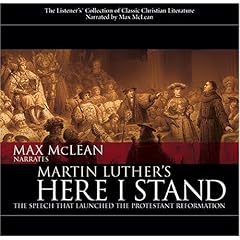
Audio Book Review


This is a pretty cool little audio book. Max McLean is the narrator and this is the least that he does. He presents the material in a very well done manner. He does more than just recite, he gives the impression that it is how Luther would have presented the speech if he were here today recounting this pivotal time.
Track Listing:

1. Introduction
2. The Road to Reformation
3. Luther’s Prayer
4. Here I Stand
5. Eck’s Response to Luther
6. Luther’s Final Response
7. Conclusion
8. Sources and closing comments

The CD starts off by giving some background to what is taking place, in not only the Roman Catholic church, but also in Luther's life. The leading up to the speech takes about 11 minutes, which not only covers the aforementioned material but also the prayer that Luther recited the night before he was to stand and defend his new found understanding of Scripture. Then the time comes to recite the speech that Martin Luther brought forth at the Diet of Worms as he began what we now see as one of the most pivotal times in all of church history.


McLean presents the entirety of not only the speech but even the questioning of Johann Eck, which is when Luther's famous words that ring so true to rebut the questioning being presented was brought forth:

My conscience is captive to the Word of God, I will not recant anything, for to go against conscience is neither honest nor safe. Here I stand, I cannot do otherwise. God help me. Amen.

I would highly recommend this audio book. The speech itself is very emotional to read, but to listen to it with such passion from Mr. McLean is something that I will enjoy for a long time. Link to buy


Read More......

Friday, November 02, 2007

Mars Hill Video Biographies

Mars Hill Seattle is currently doing a sermon series called "A Rebel's Guide to Joy" which is a study through the book of Philippians. At the end of every sermon before they are to take communion they have been showing a quick bio of the writer of the hymn they are about to sing for communion. I have enjoyed them very much and figured I would pass them on. The three that have been shown so far are Charlotte Elliot, William Cowper and Robert Robinson. Enjoy!


Read More......

Thursday, November 01, 2007

Follow Up to a Promise

Back when I was doing the online Calvinism debate I promised that I was going to give my opinion on the atonement. What I want my readers to know is that my view has changed from the limited view to now, the unlimited/limited view. I believe in the statement: Jesus Christ died for all, especially the elect. It is actually a biblical statement and is found in 1 Timothy 4:10

For it is for this we labor and strive, because we have fixed our hope on the living God, who is the Savior of all men, especially of believers.
1 Timothy 4:10

We see that God is the Saviour of all men, which is repeated from Isaiah 43:11 where God says, “I, even I, am the Lord, And there is no savior besides Me." We see that the Lord is the Saviour of all men in 1 Timothy, an unlimited atonement is in view, but then Paul also carefully carves out another people by saying "especially" of believers. This is the other side of the coin. This is the limited view of the atonement. The term for "especially" means in the Greek, "especially, chiefly, most of all, above all" So, if there is a people who are above all, then they have to be above something, here meaning someone. So two people have been atoned for, those believing and those not believing. But, Paul is careful to say that those who are the believing have a special bond and efficiency in the atonement.

If anyone thinks this to be meaning that God failed in some way, because Christ died for all yet only some are saved Richard Baxter puts it best:


"Prop. LIX Those that dare say, that Christ is an imperfect Redeemer if he do not procure Faith itself for every Man that he Dies for, (which is their Master Argument) may as well say, that God is an imperfect Creator, because he maketh not Worms to be Men; or that he is an imperfect Conservator because he preserved not man from Mortality, Damnation and Antecedent Calamities; especially from Sin: Or that he is imperfectly Merciful, because he permits Men to sin; and Condemns them: Or that Christ is an Imperfect Redeemer of the Elect, because he suffers them after his Redemption to Sin, Suffer and Die: Or, that the Holy Ghost is an imperfect Sanctifier and Caller, because many wicked Men are Sanctified and Believe imperfectly (so as will not suffice to Salvation) and because they resist and quench the Spirit, and fall from that Faith and Sanctification which they had. Or that the Spirit is an imperfect Comforter; because so many Saints Live and Die in such uncomformitable sadness: Or that Scripture is an imperfect means, because the Effect is so imperfect. In a word, they may as well say, that where God doth not overcome mens wicked dispositions, he is an imperfect God to them in regard of his Mercies: All which beseem not the Tongue of a Christian."

Richard Baxter, Universal Redemption of Mankind by the Lord Jesus Christ (London, 1694), pp. 65-66.


HT: Tony from Theological Meditations

I mean all this to say that if you would like to interact on this subject, we can do this hear or over at Theology Online where I will be starting to exegete the Scriptures that deal with the atonement. My first was today: John 3:16. Here at Contend Earnestly I will continue to focus on more of a widespread look at orthodoxy and orthopraxy, but over at Theology Online I will focus primarily on those verses dealing with the atonement.

I hope that we can keep the conversations civil and with the mind of Christ.

Soli Deo Gloria

Read More......

Wednesday, October 31, 2007

Exposition of Cain and Abel: Part II


The Angry Sinner

God gives Cain a warning the same way He warns all of us, Christian and non-Christian alike.

Look at the events here: Verses 5-7

but for Cain and for his offering He had no regard. So Cain became very angry and his countenance fell. Then the LORD said to Cain, “Why are you angry? And why has your countenance fallen? If you do well, will not your countenance be lifted up? And if you do not do well, sin is crouching at your door; and its desire is for you, but you must master it.
Genesis 4:5-7


First, Cain gets angry. Why does he get angry? Does he have any right to be angry? How many of us gets angry when we are punished? Why? Makes no sense. Its our fault! Yet we get angry. So Cain sins, and he gets angry. But notice the passage seems to indicate that he is not angry with himself for his actions but he is angry at God.

Even the Lord asks, “Why are you angry? You’re the one who sinned!”

God then shows quickly that even though Cain sinned that God is a forgiving God. By telling Cain “…if you do well” God is telling Cain that He will forgive Cain, even though Cain has sinned on his own, and is angry at God.


Who is a God like You, who pardons iniquity
And passes over the rebellious act of the remnant of His possession?
He does not retain His anger forever,
Because He delights in unchanging love.
Micah 7:18


Go and proclaim these words toward the north and say,
‘Return, faithless Israel,’ declares the LORD;
‘I will not look upon you in anger.
For I am gracious,’ declares the LORD;
‘I will not be angry forever.
Jeremiah 3:12

This idea of “if you do well” is the same as we would think of the word “repent.” The word repent means to turn from evil and to turn to Christ, to turn to good. That is what God is telling Cain. But He also gives Cain a very stern warning. That, if he continues to sin, it will master him.
It is the same that we see in Romans 6:12.

Therefore do not let sin reign in your mortal body so that you obey its lusts,
Romans 6:12

God is telling Cain what is happening in the world that Cain cannot see. God tells him what is later revealed in 1 Peter 5:8 and that is Satan is like a roaming lion, looking for someone to devour. God gives Cain a warning so that he will not fall into the temptation of his sin of anger. Christ tells us if you have anger in your heart what is that to God? It is murder.

Here, like Christ, God is telling this seemingly face to face with Cain. Think about our lives that we lead. 1 John 2:15-17 tells us not to love the things of the world, specifically John is speaking of lust of the flesh, the lust of the eyes and the boastful pride of life. Why do you think John tells us this?

What in your life adds to your sin? What in your life makes you dwell on the things not of God that are not moral? Some of these things might not even be bad things, but are you putting them above God? Have you made them an idol in your life? You know what it is in your life. This is what God is specifically telling Cain, put this anger behind you or it will devour you and you will die in your sin. This is the reason for this post. If you have made an idol out of anything, you will not be able to live a life in complete joy for Christ but your focus will be on that one thing or things.

For me, the most dangerous things for my idols are my family and my business. I have to constantly check myself to make sure that if I truly lost those things, that I would still have joy in Christ. Take what you love, if it was gone for the rest of your life tomorrow, would you have joy? If not, this thing has mastered you.

Let’s read the end here and you will see that this anger mastered Cain.

Cain told Abel his brother. And it came about when they were in the field, that Cain rose up against Abel his brother and killed him.
Genesis 4:8

Cain didn’t heed God’s words, didn’t think they were important, and everyday that you and I allow an idol in our life to continue, or a sin to continue, we do the same thing, and it will one day master us.

Read More......

Tuesday, October 30, 2007

An Exposition of Cain and Abel: Part I


As we come to this passage, many have heard of Cain murdering his brother Abel, yet many do not really understand the significance of the passage. Yes, it was the first murder in the Bible, but more so it gives us great insight to what the Lord truly wants from all of us: heart worship.

When we understand what God is crying out to us for, we can better understand that it is not our works that we are saved but by Christ’s work. I have heard many uses of this chapter. Some speak about how murder is wrong and some speak about anger, but we are going to look from a Christological showing.

We are not going to focus on the act of the actual murder but we will look at the sin of Cain and then the blood of Abel and the blood of Christ. We are going to look at the calling of God’s love of the heart, the ignorant sin of man, punishment for sin and lastly the perfect calling of Christ’s blood. Look at our text:

Genesis 4:1-16


God’s Calling for Heart Worship

Boast no more so very proudly,
Do not let arrogance come out of your mouth;
For the LORD is a God of knowledge,
And with Him actions are weighed.
1 Samuel 2:3

If there is one thing that I want to accomplish with these posts, and further posts, is to beat the religion out of you. Think of things that religious people do. What are some things that those who are seen as religious do? Reading their Bibles, memorizing Scripture, praying, helping others, going to church, etc.

What are some things that real, blood bought Christians do? Reading their Bibles, memorizing Scripture, praying, helping others, going to church, etc.

Notice a theme? They both do the same thing. So what is the difference between a religious person and a genuine blood bought Christian?

A religious person believes that those works makes God happy and appeases Him, a Christian does those works because he understands what Christ did for him on the cross. One is works the other is of a loving faith relationship with the Saviour.

Here we have two brothers, Cain and Abel. Notice that Cain is the start of what Eve probably thought was the promise declared in the curses of Satan when God said, “the woman’s seed will crush your head…” What we of course know, is that this not the case with Cain, but would have been the case with Abel, but in God’s perfect plan He allowed Cain to murder him and the promised seed ended up coming through the third son, Seth.

But, notice these two brothers. Cain was a tiller of the ground. Who was now a tiller of the ground? His father, Adam. Cain is representing here the curse of Adam. What was Abel? A keeper of flocks. What is our Christ called? The Great Shepherd

Now the God of peace, who brought up from the dead the great Shepherd of the sheep through the blood of the eternal covenant, even Jesus our Lord,
Hebrews 13:20

So we can see through this, that even though Cain was born first he was not going to be the one loved by God. We also see this with some other firstborns as well. Ishmael was born first, but Isaac was the son of promise. Esau was born first, but Jacob was the one whom God loved. So much that it is said in Romans 9:13 and Malachi 1:2 that before the boys did any right or wrong that it was Jacob whom God loved and Esau whom God hated; showing us the understanding of election and the Christian. That God places His love on a certain people before they are even born.

So, Cain and Abel we see are both keepers of something and Cain brings God a sacrifice. Some say that his sacrifice was just a plain sacrifice and others say that it was in equal value to Abel’s. It really doesn’t say, but what it does say is that God showed regard, or looked favorably to Abel’s and not Cain’s. Back to our thoughts on religion vs Chirstianity.

What is the difference between a religious person giving $100 and a Christian giving $100? What is the difference between a religious person feeding the homeless and a Christian feeding the homeless?

Each one must do just as he has purposed in his heart, not grudgingly or under compulsion, for God loves a cheerful giver.
2 Corinthians 9:7

Notice that it is said of God that He loves a cheerful giver. This word “love” is the Greek term “agape” which is the same term when Christ is said to love His sheep, same as when God says that He loves His Son. So, in my estimation this is speaking of a genuine Christian, because they are the only ones who can truly give cheerfully to God. We asked what the difference in a religious $100 and a Christian’s? This verse clears it up. A religious person does it for gain, because they are under compulsion to do so, because if they don’t God will hate them or they won’t get what they want from God. The Christian gives cheerfully because the Christian’s joy is found in God, not in money. So, if they can do anything to promote the Gospel and God’s people they cheerfully and lovingly do so.

By faith Abel offered to God a better sacrifice than Cain, through which he obtained the testimony that he was righteous, God testifying about his gifts, and through faith, though he is dead, he still speaks.
Hebrews 11:4

So, when we look at these two brothers offering their sacrifices to God, we can see what the difference was to God. Since God looks at the heart, one was doing so out of obligation, the other was doing so out of love for his God, by faith.

Was it God’s fault that Cain didn’t offer out of love? No, it was Cain’s sin.

So when you spread out your hands in prayer,
I will hide My eyes from you;
Yes, even though you multiply prayers,
I will not listen.
Your hands are covered with blood.
Isaiah 1:15

God tells Israel that He will not listen to their unrepentant hearts. He says earlier that He wishes that they wouldn’t even bother sacrificing to Him and then ends with this verse. He basically is telling them that all you are doing is standing their speaking to no one, cause God isn’t listening, and you aren’t even sacrificing, but you are just standing there with blood on your hands, meaning it hasn’t accomplished anything.

Same with us. God desires nothing from us, besides our hearts. I have heard one preacher put it, don’t make church a hobby for yourself. I will tell you the same thing. Don’t make church your hobby, it is the stupidest hobby you could have, go play video games or snow board, do something fun with your life, but don’t go to church acting as though you desire to be one of God’s own, when all you do is lip service. If you are doing all these things because God says so, or because you are “supposed to”, such as: reading your Bible, memorizing Scripture, praying, helping others, going to church, etc., you are just doing what the Israelites did…you are just standing there with blood on your hands, speaking to the walls, cause God isn’t listening to you.

You don’t care, and guess what, neither does God.

This is what Cain was. He was just a dude doing what God told him to do. No love or devotion in his heart towards his maker, but a religious man with no knowledge of what God truly desired from him. Therefore, God didn’t regard his sacrifice, but we will get into that in our next post.

Read More......

Monday, October 29, 2007

Imputation: When does it occur?


I had a “conversation” today about when Christ’s righteousness was imputed to His elect. The one I was speaking to said that the imputation of Christ’s righteousness to us happened at the cross. Just so that there is no confusion in this matter, let’s define imputation:

The act of God declaring that our sins belong to Christ (another word is “reckon”) and Christ’s righteousness belonging to us. Although in this instance neither is deserving of the other, it is made so by God’s declaration.

The most famous verse that states this truth is 2 Corinthians 5:21

He made Him who knew no sin to be sin on our behalf, so that we might become the righteousness of God in Him.
2 Corinthians 5:21


So that, as our sins were imputed to Christ, God imputed Christ's righteousness to us. This fact is traditional in orthodoxy but much disputed as when this actually takes place. There is another instance of where we find something being imputed to another in the Bible and it comes when speaking of Adam’s sin being imputed to the entire human race:

Therefore, just as through one man sin entered into the world, and death through sin, and so death spread to all men, because all sinned—
Romans 5:12

So, when does this happen? When does Christ’s righteousness get imputed, or reckoned to us? It happens at the time of our faith. It is in essence the entire reasoning and understanding of the great reformation dogma, Sola Fide. The first we see of this happens in the Old Testament when speaking of Abram:

Then he believed in the LORD; and He reckoned it to him as righteousness.
Genesis 15:6

Notice when righteousness was reckoned, or imputed, or judged to be in force: it happened at faith. In belief of God.

Paul’s whole disputation on the gift of faith and reckoning comes in Galatians 3 and is proved in respect of this by proving it through the Old Testament man, Abraham:


This is the only thing I want to find out from you: did you receive the Spirit by the works of the Law, or by hearing with faith? Are you so foolish? Having begun by the Spirit, are you now being perfected by the flesh? Did you suffer so many things in vain—if indeed it was in vain? So then, does He who provides you with the Spirit and works miracles among you, do it by the works of the Law, or by hearing with faith? Even so Abraham BELIEVED GOD, AND IT WAS RECKONED TO HIM AS RIGHTEOUSNESS.
Galatians 3:2-6

And another point to the time of faith being when we are reckoned, or imputed Christ’s righteousness:


But now apart from the Law the righteousness of God has been manifested, being witnessed by the Law and the Prophets, even the righteousness of God through faith in Jesus Christ for all those who believe; for there is no distinction;
Romans 3:21-22


This is also why we can say that you are saved by grace THROUGH faith. So we are saved by the blood of Christ, and his righteousness is then imputed to the elect, when they have been regenerated, given faith, and then believe.

The question might be asked, “Why can’t Christ’s righteousness just be given by God to the elect at the cross?” Besides the many Scriptures spoken of the imputation happening at faith, the other reason happens when we see such Scriptures that say that we were once “children of wrath (Eph 2:3)” “hated by God (Psalm 5:5)” “sons of disobedience (Eph 2:2)” and “sons of the devil (John 8:44).” If this is the case, how can we be deemed righteous and still have God’s wrath against us? This cannot be. Therefore there is a time where Christ died, and the elect CAN still be seen as under HIS wrath. So what happens to change our position before God? Faith.

Therefore, having been justified by faith, we have peace with God through our Lord Jesus Christ,
Romans 5:1

If Christ’s righteousness was imputed at his death to his people, the elect could have never been under the wrath of God. But, Paul makes this clear as he says in Ephesians 2:3 that WE were by nature children of wrath. Paul includes himself so to say that there was a time that we were without Christ’s righteousness even though Christ had already died.

In my view this is an “already not yet” scenario. Christ’s death has conquered death already, but not yet imputed to us who will, 100% believe.

The verse from the one that I was conversing to kept pointing to Romans 5:10 where it says:

For if while we were enemies we were reconciled to God through the death of His Son, much more, having been reconciled, we shall be saved by His life.
Romans 5:10

What needs to be understood is to be seen before this, which happens to be the thesis of this passage, and then also a verse later down that gives us this reality. We already saw the thesis, which is, Romans 5:1

Therefore, having been justified by faith, we have peace with God through our Lord Jesus Christ

Paul then goes through what we have this faith in, and that is in the death of Christ for us. It is to remove our sins from Adam to our own personal sin, to impute those sins to Christ, and then for Christ to eventually impute to us His righteousness which is shown to happen in the future through verse 19:

For as through the one man’s disobedience the many were made sinners, even so through the obedience of the One the many will be made righteous.
Romans 5:19


Notice that it says that the many WILL BE made righteous. This in effect is speaking of something that has not happened yet, even though the death of Christ our mediator has already taken place. This, in essence, is the defintion of an "already, not yet" scenario.

So, what we see from this extremely short post on the subject is the fact that faith plays an intricate part to understanding imputation. If we have been imputed Christ’s righteousness literally at the cross then there is no chance that we can ever be under the wrath of God, which Ephesians 2 speaks directly against. If you would like more info on the understanding of the faith that is only given by God look to the posts on Sola Fide here, here and here.


Read More......
Related Posts with Thumbnails